Supply preferences and productive electricity use constraints among micro and small enterprises in Bihar, India
Good grid supply, yet 40% of Bihar micro-firms stay unconnected
Whether supply is what constrains small firms
Programmes to encourage productive electricity use among micro and small enterprises generally assume that supply is the binding constraint, and that improving reliability or lowering tariffs will unlock enterprise growth. In Bihar, one of India's poorest states, that assumption has rarely been tested against what enterprise owners themselves would choose.
We ask what electricity supply attributes micro and small enterprises prefer, and what constrains their productive electricity use. The distinction matters for policy design. If reliability and cost are the constraint, supply-side investment is the remedy; if the constraint sits instead in what firms are equipped to do with electricity once they have it, then supply improvements will be necessary without being sufficient, and a programme built entirely around them will underdeliver. Establishing which of the two holds requires measuring both the supply conditions firms currently face and the trade-offs they are willing to make between competing supply offers.
A conjoint experiment with 696 enterprise owners
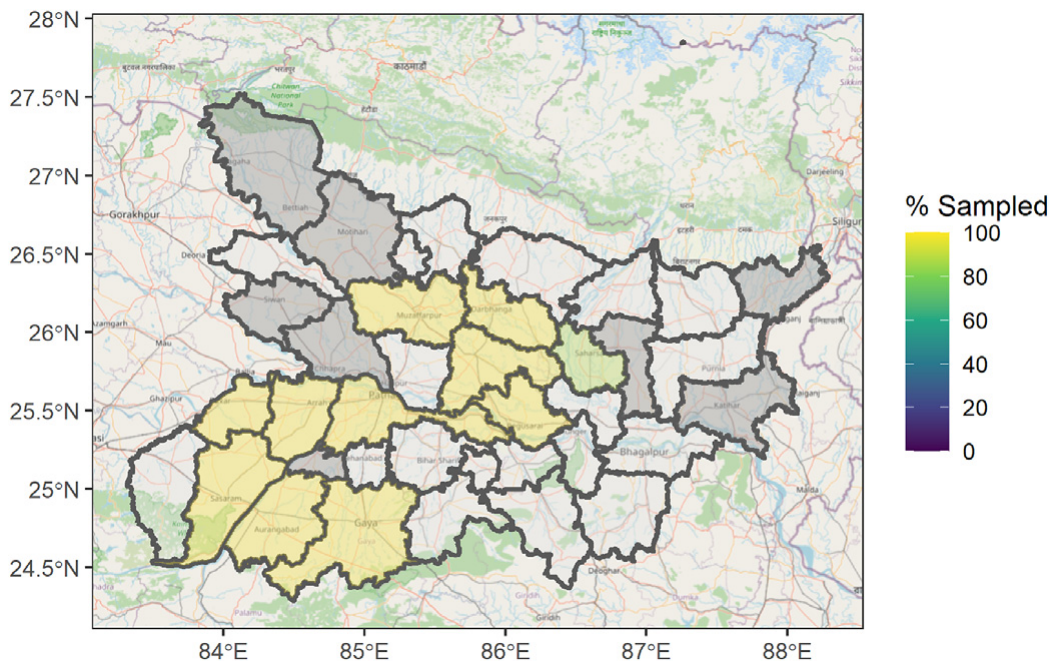
We surveyed 696 micro and small enterprise owners across Bihar, using stratified random sampling with districts selected by probability weighting on the number of non-farm employed adults, villages and towns selected within districts stratified by urban and rural shares, and enterprises selected by a skip rule from the centre of each enumeration area. Data collection was interrupted by the outbreak of the COVID-19 pandemic in March 2020, and we note that the realised sample is not technically representative of all of Bihar.
Each respondent completed a pre-registered conjoint experiment twice, yielding 2,784 observations, in which two hypothetical supply options were constructed by randomly drawing from six attributes: availability of 6, 12, 18 or 24 hours per day; 0, 1, 5, 10 or 15 blackouts per month; the same range of voltage-fluctuation days; power sufficient for lights and phone charging only or for any appliance needed; supply from the grid or a microgrid; and a cost of between 1 and 30 rupees per kWh. Standard errors are clustered at the enterprise level, and we use Bayesian Additive Regression Trees to estimate heterogeneous effects across firm characteristics.
Supply is adequate and capabilities are the constraint
We find that reported grid electricity supply reliability is high, providing on average 18.7 hours of electricity per day and less than one day with blackouts or voltage fluctuation per month. Yet 60% of sampled enterprises have a grid connection, 23% use off-grid sources exclusively, and 17% report no use of electricity whatsoever; among those without a grid connection, the majority cited poor affordability at 53%, followed by no necessity at 35%.
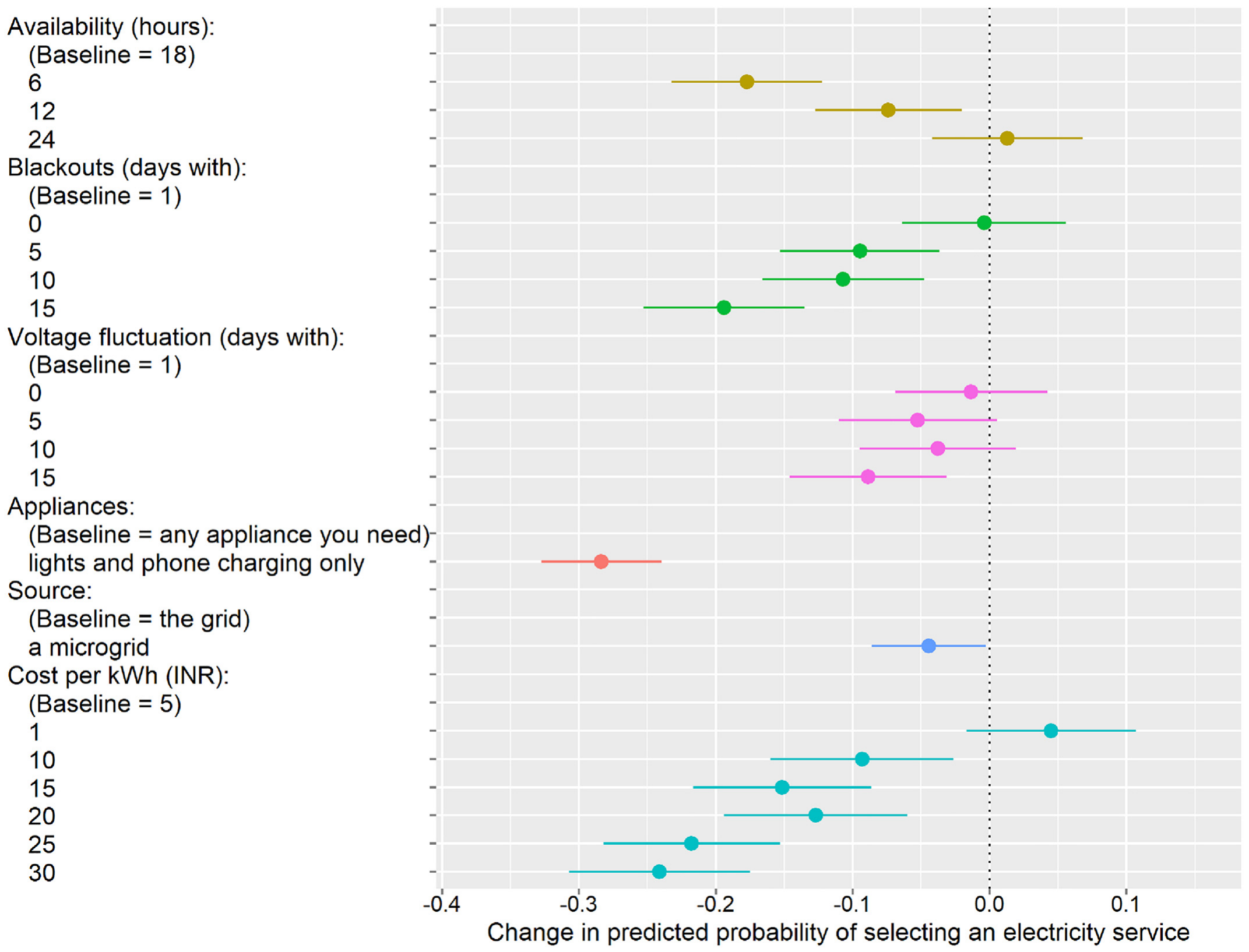
The conjoint results show firms responding as expected to supply attributes, but modestly. A drop in availability from 18 to 12 hours reduces the predicted likelihood of accepting an offer by 7.4 percentage points [95% CI: 2.0 to 12.7], and an increase in blackout days from 1 to 5 by 9.5 percentage points [3.7 to 15.3], while the equivalent change in voltage-fluctuation days was small and not statistically significant. Doubling the price from 5 to 10 rupees per kWh reduces acceptance by 9.3 percentage points [2.6 to 15.0]. By far the largest effect comes from restricting usage to lighting and phone charging, at 28.3 percentage points [24.0 to 32.8]. Even after connection, 75% of firms consume on average under 2 kWh per day.
Look beyond supply towards use stimulation
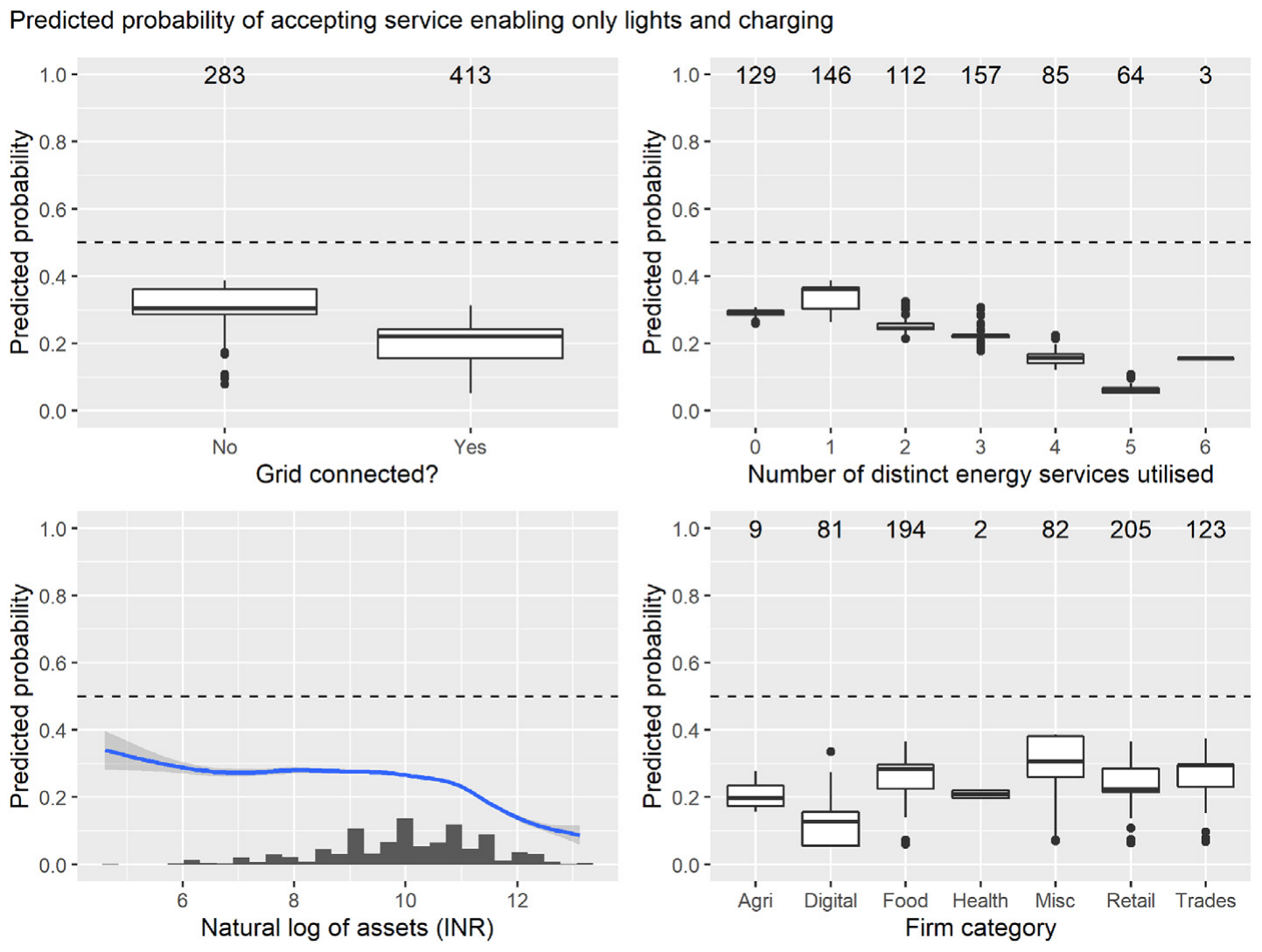
The pattern in these results points away from the supply-side diagnosis. Firms care most about whether the supply can run any appliance they need, rather than about the marginal hour or the marginal blackout, and their observed consumption remains low even where reliability is already high. Asked directly about business constraints, respondents rated timely payment by customers, access to credit and corruption as the most pressing problems, among grid-connected and other electrified firms alike.
Overall, the results of the conjoint experiment indicate that electricity reliability and costs are unlikely to be a serious business constraint among the majority of Bihari micro and small enterprises, notwithstanding the minority of larger firms that may indeed respond positively to reductions in electricity costs. The main policy challenge regarding productive electricity use among these firms appears to be their limited capabilities to purchase appliances and modify existing productive processes. We argue that policy reform in Bihar aiming to encourage productive electricity use should look beyond supply improvements towards productive electricity use stimulation.
@article{pelz_supply_2022,
	title = {Supply preferences and productive electricity use constraints among micro and small enterprises in {Bihar}, {India}},
	volume = {67},
	copyright = {All rights reserved},
	issn = {09730826},
	url = {https://linkinghub.elsevier.com/retrieve/pii/S0973082622000059},
	doi = {10.1016/j.esd.2022.01.004},
	language = {en},
	urldate = {2023-01-28},
	journal = {Energy for Sustainable Development},
	author = {Pelz, Setu and Aklin, Michaël and Urpelainen, Johannes},
	month = apr,
	year = {2022},
	pages = {151--162},
}