Using net-zero carbon debt to track climate overshoot responsibility
A forward-looking measure of regional responsibility for breaching a fair share of the 1.5C budget
Regional responsibility once overshoot begins
Contemporary guidance on climate deliberations must grapple with a dwindling remaining carbon budget, which recent estimates place at approximately 200 GtCO2 for a 50% chance of staying below 1.5C from 2024. On current trends that budget is depleted around 2030, which makes at least a temporary overshoot of the 1.5C limit close to unavoidable.
This creates a problem for effort-sharing. Most 'fair share' measures are defined against a budget that still exists, and they cease to apply once the budget is exhausted and the question of who is responsible becomes most contested. We ask whether a forward-looking measure of responsibility can survive budget depletion, and what it implies for the drawdown obligations that follow. We contend that relaxing the temperature limit in response is inherently inequitable, disproportionately harming vulnerable populations and increasing the likelihood of irreversible climate impacts, so the measure has to hold the limit fixed and describe the return to it.
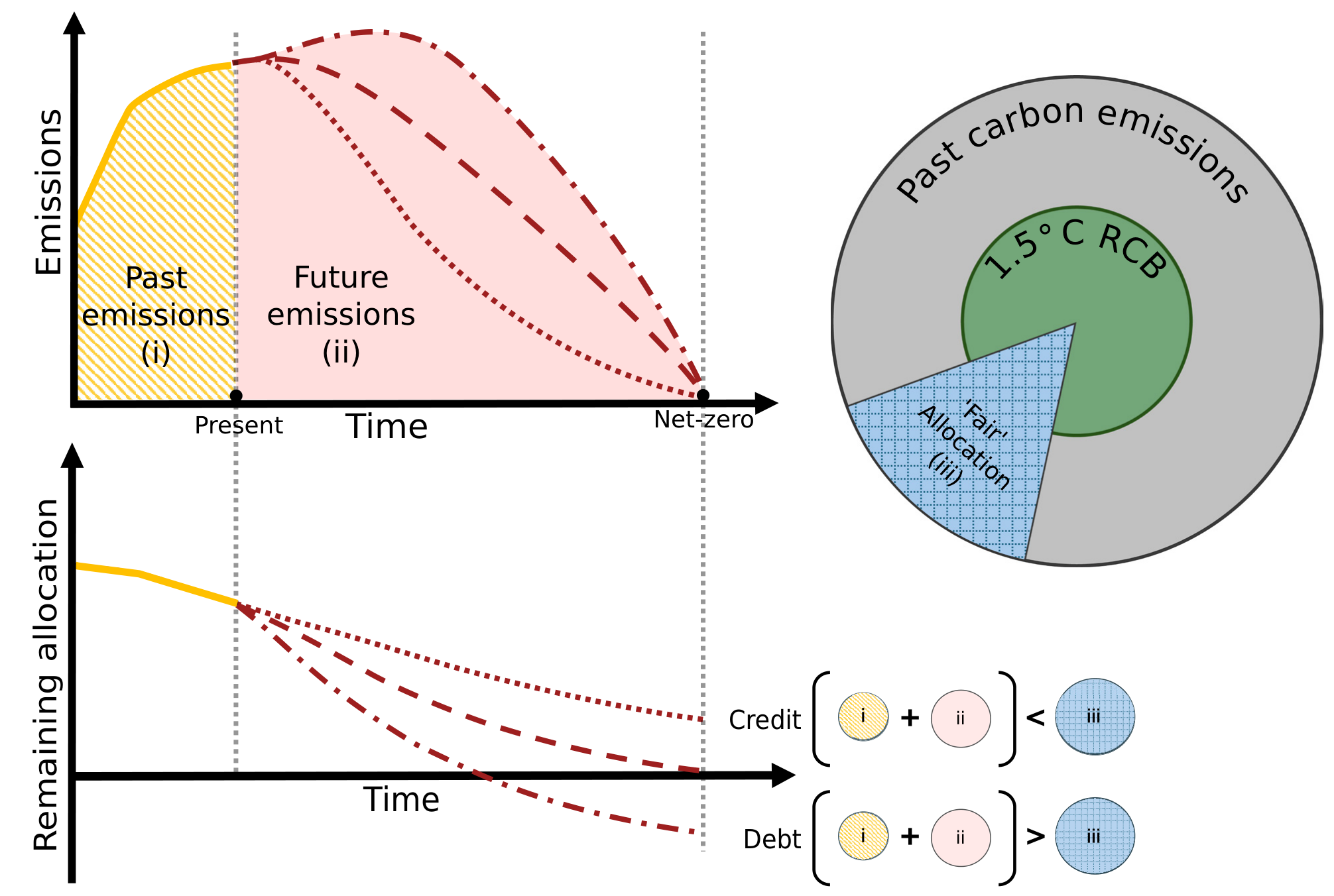
Allocate the budget, then measure the breach
We define 'net-zero carbon debt' as the extent to which a region breaches its fair share of the remaining 1.5C budget by the time it reaches net-zero CO2 from fossil fuels and industry. We apply it to all vetted scenarios in the IPCC AR6 WGIII database, subset to those in which every region reaches net-zero this century and grouped into decadal net-zero timing bins, alongside two constructed pathways: CurPol, reflecting current policies, and CurPledge, reflecting all conditional and unconditional pledges and net-zero targets.
The illustrative allocation is equal cumulative per capita, applied to a total budget comprising global CO2-FFI emissions from 1990 to 2022 plus a remaining 1.5C budget of approximately 247 GtCO2 from 2023, distributed across global population from 1990 to 2050. Results are reported for the ten IAMC regions. We use the simple climate model FaIR to derive temperature outcomes, and to test the equivalence between gross emissions before net-zero and permanent net-negative sequestration afterwards, finding an approximate one-to-one long-term relationship with 25% uncertainty in either direction.
Debts persist, and they fall unevenly
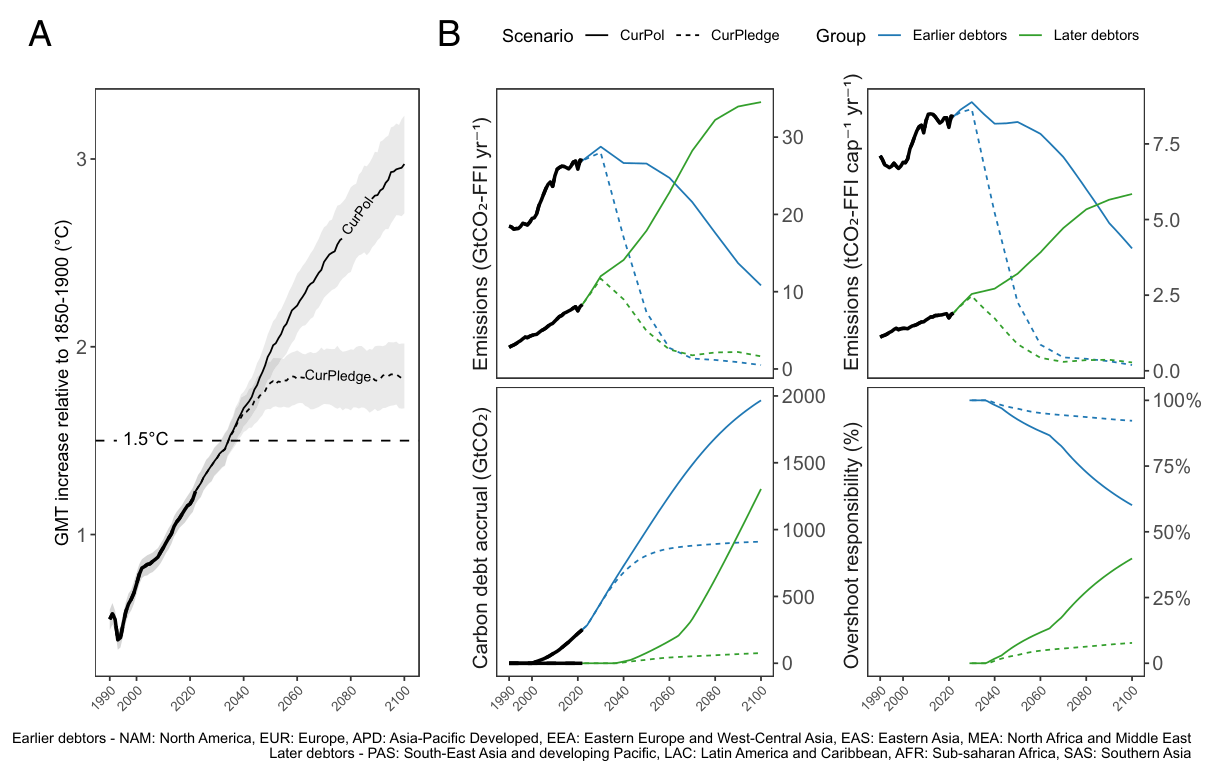
We find that regional debts persist across pathways, with stark interregional disparities. Under median regional pathways achieving net-zero CO2-FFI by 2050, net-zero carbon debt reaches 201.4 GtCO2 in North America and 101.2 GtCO2 in Eastern Asia. Grouping regions into 'earlier debtors', which exhaust their allocation before 2030 and hold approximately 42% of the 2022 global population, and 'later debtors', which do so afterwards and hold approximately 58%, separates near-term from long-term responsibility.
Under CurPledge, later debtors initially account for only 3% of total budget exceedance in the year of peak temperature increase, indicating minimal responsibility for the immediate impacts of overshoot in a world where stated targets are met. Under CurPol, prolonged late-century emissions raise that share to 40% by 2100. Global mean temperature peaks at approximately 1.8C by 2050 under CurPledge and rises to approximately 3C by 2100 under CurPol. Above-average annual per capita drawdown obligations reach 5.1 tCO2 per capita per year under CurPledge and 7.3 under CurPol, against recent regional per capita emissions of 9.5 tCO2 in 2022.
A measure that survives budget depletion
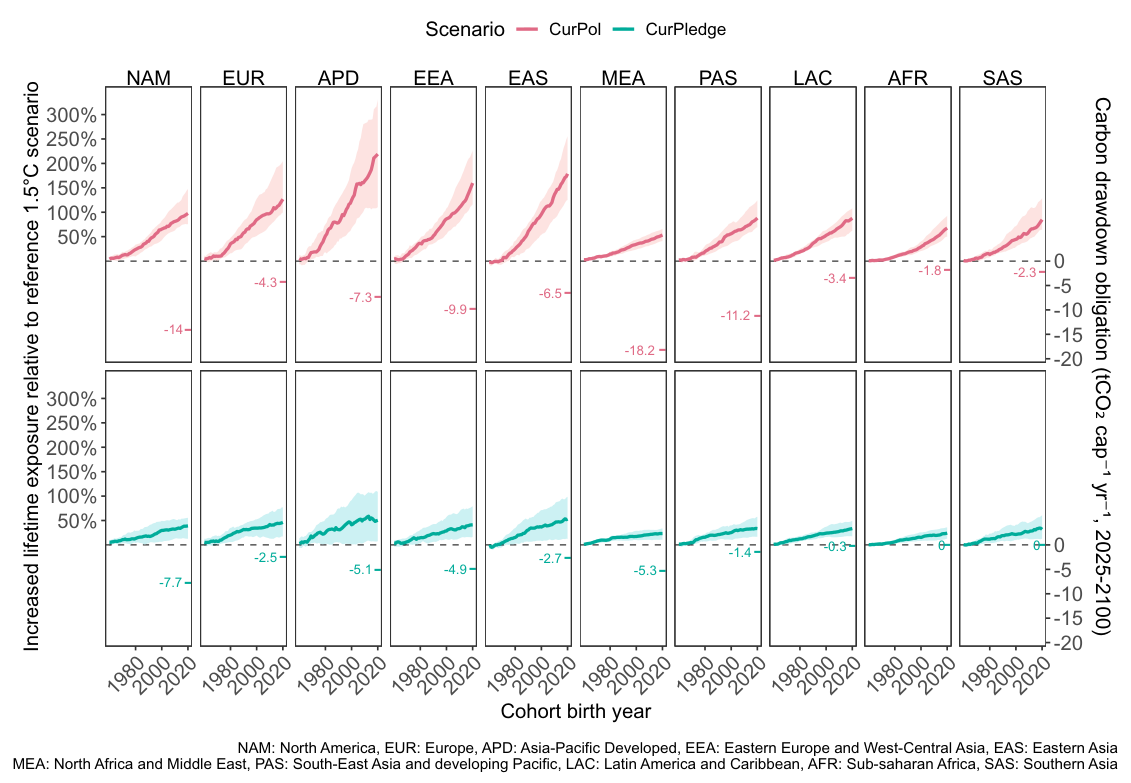
These debts map onto an intergenerational burden. In the Asia-Pacific Developed region, the cohort born in 2020 faces an approximate 50% increase in lifetime extreme heatwave exposure under CurPledge, double that of the 1980 cohort, and an approximate 220% increase under CurPol, over four times the 1980 cohort's increase.
We argue that a persistent measure of responsibility robust to budget depletion is of value, as it draws a line at the acceptable level of warming and guides the return to that level, fairly. Two futures present themselves. In an uncooperative world, where substantial net-zero carbon debts persist, we will likely witness severe long-term exceedance of the 1.5C limit, with the associated impacts primarily experienced by younger generations. In a world where regional net-zero carbon debt is rapidly eliminated through mutually beneficial cooperation, efforts can instead pivot toward identifying and striving for long-term temperature reduction targets. The measure is a step towards effort-sharing that remains meaningful after the remaining budget is gone.
@article{pelz_using_2025,
	title = {Using net-zero carbon debt to track climate overshoot responsibility},
	volume = {122},
	copyright = {All rights reserved},
	issn = {0027-8424, 1091-6490},
	url = {https://pnas.org/doi/10.1073/pnas.2409316122},
	doi = {10.1073/pnas.2409316122},
	abstract = {Current emissions trends will likely deplete a 1.5 °C consistent carbon budget around the year 2030, resulting in at least a temporary exceedance, or overshoot. To clarify responsibilities for this budget exceedance, we consider “net-zero carbon debt,” a forward-looking measure of the extent to which a party is expected to breach its “fair share” of the remaining budget by the time it achieves net-zero carbon emissions. We apply this measure to all vetted mitigation scenarios assessed in the Intergovernmental Panel on Climate Change’s Sixth Assessment Report and two scenarios that model current policies and pledges, using an illustrative equal per capita allocation of a remaining 1.5 °C carbon budget starting in 1990. The resulting regional carbon debt estimates inform i) the scale and pace of regional carbon drawdown obligations necessary to address budget exceedance and ii) relative regional responsibilities for increased lifetime exposure to extreme heatwaves across age cohorts due to budget exceedance. Our work strengthens intergenerational equity considerations within an international climate equity discourse and informs the implementation of effort-sharing mechanisms that persist beyond the exhaustion of a rapidly dwindling remaining carbon budget.},
	language = {en},
	number = {13},
	urldate = {2025-04-03},
	journal = {Proceedings of the National Academy of Sciences},
	author = {Pelz, Setu and Ganti, Gaurav and Lamboll, Robin and Grant, Luke and Smith, Chris and Pachauri, Shonali and Rogelj, Joeri and Riahi, Keywan and Thiery, Wim and Gidden, Matthew J.},
	month = apr,
	year = {2025},
	pages = {e2409316122},
}