A dataset of income distribution on provincial, urban, and rural levels for China from 2020 to 2100
Machine-learning projections of income distribution for 31 Chinese provinces, 2020-2100
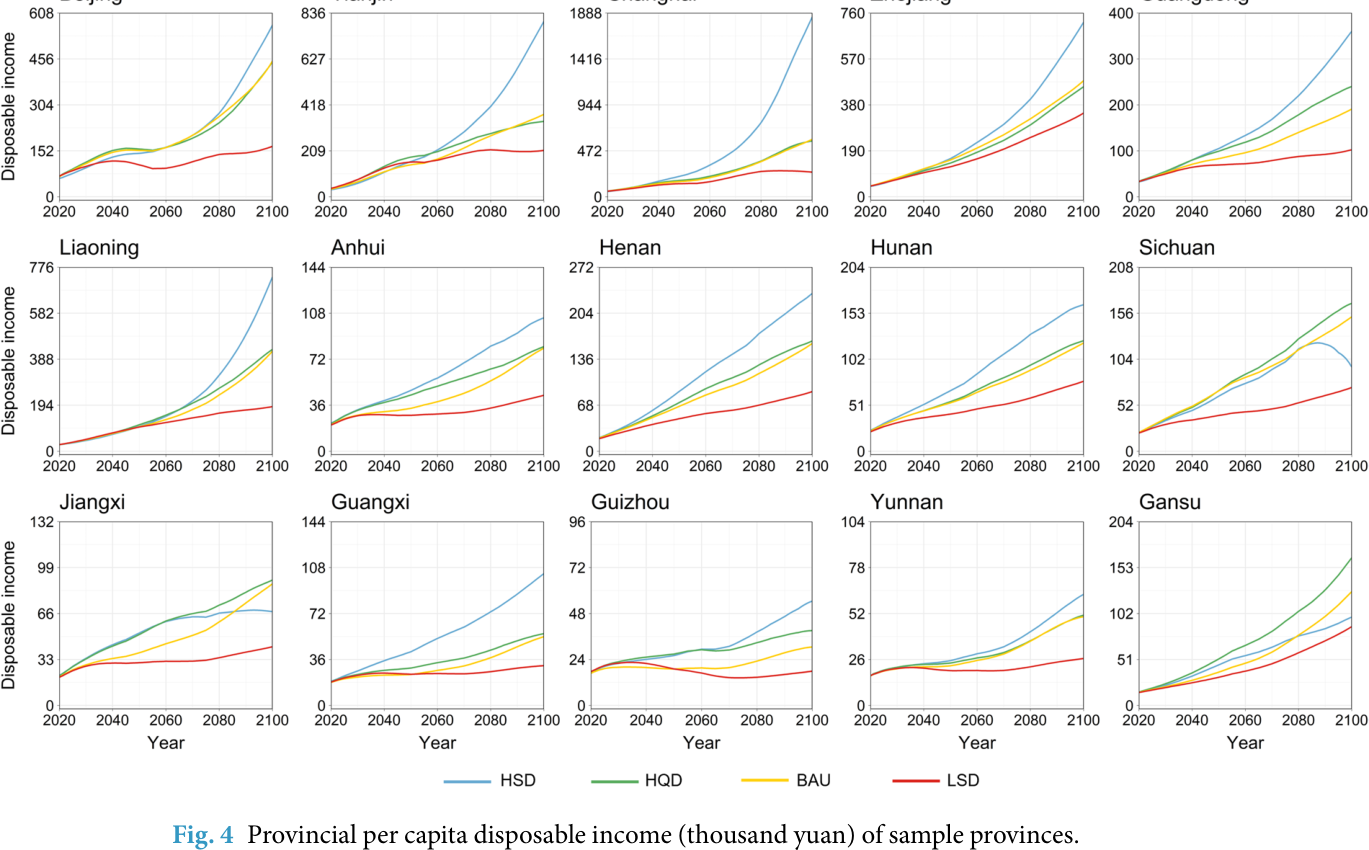
We introduce a methodological framework that brings machine learning algorithms into a top-down approach for generating income distribution datasets. We project per capita disposable income and income inequality for 31 Chinese provinces from 2020 to 2100 across scenarios grounded in China's local circumstances, then estimate the income distributions that follow.
After enforcing consistency across provincial, urban, and rural income datasets, we generate the same data products at the urban and rural level for each province. We validate our projections against China's disposable income data for 2007-2023, provincial income inequality for 2007-2019, and national income inequality over the past 20 to 60 years from selected developed countries.
The methodology is flexible: users can generate similar data products to their own specifications. We argue the resulting datasets have wide application, serving as inputs for research on drivers and impacts across social, economic, and environmental domains.
@article{lei_dataset_2024,
	title = {A dataset of income distribution on provincial, urban, and rural levels for {China} from 2020 to 2100},
	volume = {11},
	copyright = {All rights reserved},
	issn = {2052-4463},
	url = {https://www.nature.com/articles/s41597-024-04304-x},
	doi = {10.1038/s41597-024-04304-x},
	language = {en},
	number = {1},
	urldate = {2025-01-05},
	journal = {Scientific Data},
	author = {Lei, Mingyu and Pelz, Setu and Pachauri, Shonali and Cai, Wenjia},
	month = dec,
	year = {2024},
	pages = {1436},
}