Women's decision-making power, cooking fuel adoption and appliance ownership: Evidence from Rwanda, Nepal and Honduras
We find women's decision-making power is associated with cleaner cooking, but context conditions it
We examine how women's decision-making power within a household relates to cooking-fuel choices and appliance ownership in Honduras, Nepal and Rwanda. Using household and individual data from the World Bank's Multi-Tier Framework Surveys, we develop a measure to proxy 'women's decision-making power' and assess how it correlates with energy choices.
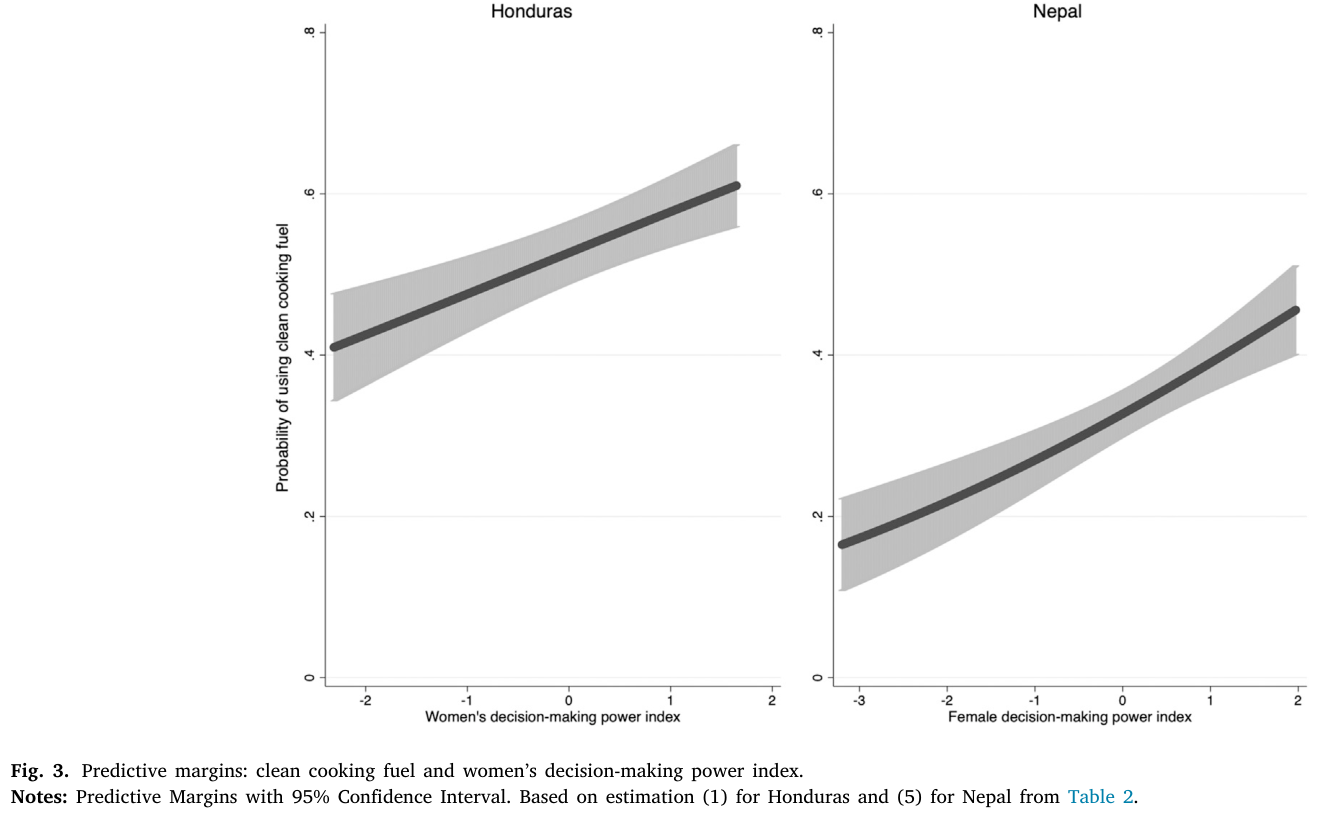
We find that Honduran and Nepalese households are up to 20 and 30 percentage points more likely to use clean cooking fuels where women experience high decision-making power, but find no such association in Rwanda. Appliance ownership is more mixed: in Honduras and Nepal, higher women's decision-making power is associated with owning a range of appliances more often, though no general cross-country pattern holds; in Rwanda, these households own leisure-related devices less often.
These descriptive findings suggest gender- and context-specific preferences over household energy use. We argue this matters for how energy access is measured and for designing context-aware interventions.
@article{flechtner_womens_2024,
	title = {Women’s decision-making power, cooking fuel adoption and appliance ownership: {Evidence} from {Rwanda}, {Nepal} and {Honduras}},
	volume = {118},
	copyright = {All rights reserved},
	issn = {22146296},
	shorttitle = {Women’s decision-making power, cooking fuel adoption and appliance ownership},
	url = {https://linkinghub.elsevier.com/retrieve/pii/S2214629624003712},
	doi = {10.1016/j.erss.2024.103780},
	language = {en},
	urldate = {2024-10-22},
	journal = {Energy Research \& Social Science},
	author = {Flechtner, Svenja and Lich, Ulli and Pelz, Setu},
	month = dec,
	year = {2024},
	pages = {103780},
}