Balancing energy transition: Assessing decent living standards and future energy demand in the Global South
We ask how India can meet decent living standards while curbing residential energy demand
Read the published paper ↗doi.org/10.1016/j.erss.2024.103757
We argue that blanket energy-demand reduction is not advisable across the Global South, where critical gaps in access to basic services still leave 'decent living standards' (DLS) unmet. Most energy-demand scenarios overlook DLS achievement, and model limitations in representing distributional aspects make it hard to model the energy needed to meet them. Drawing on a set of detailed sectoral and integrated assessment models, we operationalise four DLS dimensions for the residential sector in India: sufficient space and durable housing, thermal comfort, access to basic appliances, and clean cooking.
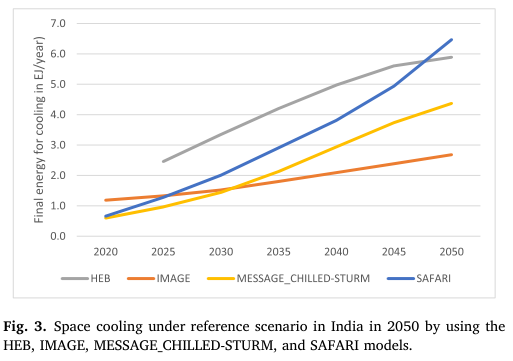
We find that a substantial rise in residential floor area will not guarantee better DLS, because non-durable housing construction continues. Space cooling demand increases by 126–800% by 2050 across models, yet only about 15% of the population will have residential air conditioning by then, mostly in urban buildings. Improving well-being and reducing energy demand can therefore appear to be divergent goals.
Clean cooking is the counter-case. Access rises to almost 80% under current policies, while two of the models project cooking energy demand falling by 24–49% by 2050. The decline comes from more efficient clean cooking stoves displacing traditional biomass, although one model projects a small increase. This suggests that high-efficiency measures can reconcile the seemingly divergent goals of improving well-being and reducing energy demand.
@article{chatterjee_balancing_2024,
	title = {Balancing energy transition: {Assessing} decent living standards and future energy demand in the {Global} {South}},
	copyright = {All rights reserved},
	issn = {22146296},
	shorttitle = {Balancing energy transition},
	url = {https://linkinghub.elsevier.com/retrieve/pii/S2214629624003487},
	doi = {10.1016/j.erss.2024.103757},
	language = {en},
	urldate = {2024-10-22},
	journal = {Energy Research \& Social Science},
	author = {Chatterjee, Souran and Mastrucci, Alessio and Niamir, Leila and Ashok, Kaveri and Sreenivas, Ashok and Dukkipati, Srihari and Daioglou, Vassilis and Edelenbosch, Oreane and Pelz, Setu and Boza-Kiss, Benigna and Kumar, Poornima and Ürge-Vorsatz, Diána},
	month = sep,
	year = {2024},
	pages = {103757},
}