Aligning differentiated mitigation capacity with the Paris agreement goals
Eight IAMs shift near-term mitigation toward higher-capacity regions, within Paris-aligned limits
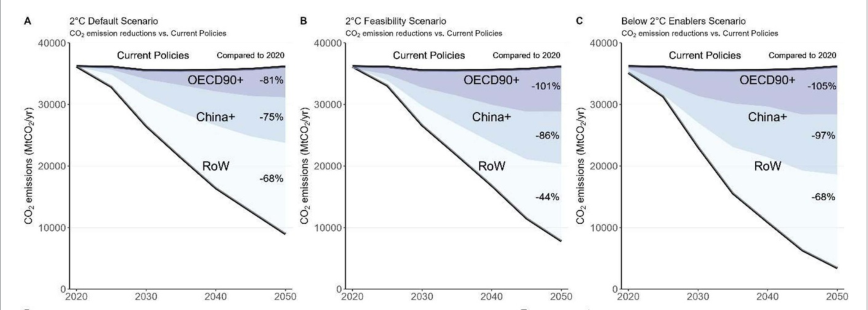
Using a new set of scenarios from eight global integrated assessment models, we shift near-term mitigation effort towards regions with greater mitigation capacity, applying differentiated carbon pricing and emission caps in place of the default uniform global carbon price, while staying within the scenario space aligned with the Paris Agreement's goal of holding warming well below 2 C and pursuing 1.5 C. We operationalise 'mitigation capacity' through institutional capacity, consistent with a capacity-based conception of regional fairness.
In the most ambitious scenario, OECD countries reduce CO2 emissions by around 85% (range 81%-114%) by 2040 relative to 2020 and reach net zero around 2045, well beyond the 58% reduction (range 33%-71%) projected under default uniform-price 2 C pathways. China reduces CO2 by 78% (range 55%-83%) by 2040 and reaches net zero by 2050, against a 50% default reduction, while other regions aim for net zero by 2070. This redistribution implies an accelerated phase-out of coal, oil, and gas concentrated in the OECD and, to some extent, China, alongside final energy demand reductions that go beyond current pledges.
We argue that integrating feasibility and capacity-based fairness into scenario design yields pathways that are, in some respects, more policy-relevant. The contribution is to expand the Paris-aligned scenario space and respond to recent critiques of how global IAMs distribute mitigation effort.
@article{brutschin_aligning_2025,
	title = {Aligning differentiated mitigation capacity with the {Paris} agreement goals},
	volume = {4},
	copyright = {All rights reserved},
	issn = {2752-5295},
	url = {https://iopscience.iop.org/article/10.1088/2752-5295/ae0ea5},
	doi = {10.1088/2752-5295/ae0ea5},
	abstract = {Abstract

              Regional disparities in mitigation capacity and the slow deployment of certain novel technologies pose significant challenges to achieving ambitious climate goals. We explore how accounting for technological and mitigation capacity considerations alters the regional distribution of mitigation efforts, and how these shifts relate to fairness considerations, all while staying within the scenario space aligned with the Paris Agreement’s goal of holding the increase in the global average temperature to well below 2 °C above pre-industrial levels and pursuing efforts to limit the temperature increase to 1.5 °C above pre-industrial levels. To do so, we use a new set of scenarios generated using eight global integrated assessment models (IAMs). These scenarios shift near-term mitigation efforts to regions with greater mitigation capacity by implementing differentiated carbon pricing and emission caps, deviating from the default assumption of a uniform carbon price in global IAMs. We examine the scale of regional emissions reductions and energy system transformations needed, highlighting the implications in the near term. Our findings from the most ambitious scenario, highlight that Organisation for Economic Co-operation and Development (OECD) countries could reduce total CO
              2
              emissions as reported in the models by approximately 85\% (range: 81\%–114\%) by 2040 relative to 2020 levels and achieve net-zero CO
              2
              emissions around 2045—well beyond the 58\% reduction (range: 33\%–71\%) projected under default 2 °C pathways with a globally uniform carbon price. Similarly, China could reduce CO
              2
              emissions by 78\% (range: 55\%–83\%) by 2040 and reach net-zero by 2050, compared to a 50\% reduction (range: 47\%–72\%) in default scenarios. In this ambitious scenario, other regions could aim to reach net-zero CO
              2
              by 2070. This redistribution of mitigation efforts involves an accelerated phase-out of fossil fuels—coal, oil, and gas—primarily within the OECD region and, to a certain extent, in China. It also includes an early—but, in line with our feasibility considerations, limited—scale-up of carbon capture and storage capacity, along with significant reductions in final energy demand that go beyond current pledges and ambition levels. Beyond feasibility considerations, the new scenarios assume more mitigation efforts in regions with higher mitigation capacity proxied through institutional capacity, consistent with a capacity-based conception of regional fairness. Integrating certain considerations of feasibility and fairness into scenario assessments enables the development of alternative pathways that are, in some respects, more policy-relevant and help expand the scenario space—thereby responding to some of the recent critiques of global IAMs.},
	language = {en},
	number = {4},
	urldate = {2026-01-13},
	journal = {Environmental Research: Climate},
	author = {Brutschin, Elina and Bertram, Christoph and Baptista, Luiz Bernardo and Bosetti, Valentina and Daioglou, Vassilis and De Boer, Harmen Sytze and Drouet, Laurent and Fosse, Florian and Fragkiadakis, Dimitrios and Fragkiadakis, Kostas and Fricko, Oliver and Fujimori, Shinichiro and Kejun, Jiang and Krey, Volker and Kikstra, Jarmo and Pianta, Silvia and Pelz, Setu and Riahi, Keywan and Richters, Oliver and Rodrigues, Renato and Schaeffer, Roberto and Scheifinger, Karl and Silva, Diego and Tagomori, Isabela and Van Ruijven, Bas and Van Vuuren, Detlef and Vrontisi, Zoi},
	month = dec,
	year = {2025},
	pages = {045012},
}