Application of an alternative framework for measuring progress towards SDG 7.1
Binary SDG 7.1 indicators overstate progress; many 'served' households lack affordable, reliable supply
What official access counts miss
The official SDG 7.1 indicators identify about 789 million people as without access to electricity in 2018, yet recent estimates suggest that as many as 3.5 billion people live without access to reliable electricity. The gap between those two figures arises from what the official indicators are built to measure, rather than from a lack of data.
Target 7.1 commits to affordable, reliable and modern energy services, but the indicators used to track it are binary and unidimensional, measuring access by connections to a modern energy source rather than by the supply provided or the use made of it. A household counted as having access may receive a few hours of supply a day, may be unable to afford the electricity it is nominally connected to, and may still be cooking primarily on solid fuel. We ask how far the official picture shifts when connection-based counting is replaced with a multi-dimensional alternative applied to the same households.
Three joint dimensions across ten national surveys
We apply an alternative framework that aligns as closely as possible to the wording of the SDG 7.1 target and builds on the World Bank Multi-Tier Framework, while distinguishing between the quality of supply provided and the capability to translate that supply into energy services meeting end-user needs. Rather than a tier ladder, we reduce the tiers into a single set of decent access thresholds that must be satisfied jointly.
For electricity, a household must utilise at least decent energy services, defined as access to at least light, phone, and either television, fridge or cooling; must have electricity available for at least 16 hours per day; and must spend no more than 5% of median quintile expenditures on it. For clean cooking, a household must use stoves running on biogas, liquefied petroleum gas, electricity or natural gas for at least 80% of daily cooking time, must have those fuels available for 10 months of the year, and must meet the same 5% affordability test. We apply this to nationally representative Multi-Tier Framework surveys across ten countries, spanning Rwanda, Ethiopia, Cambodia, Myanmar, Honduras, Nepal, Kenya, Niger, Sao Tome and Principe, and Zambia.
Affordability is the most widespread binding constraint
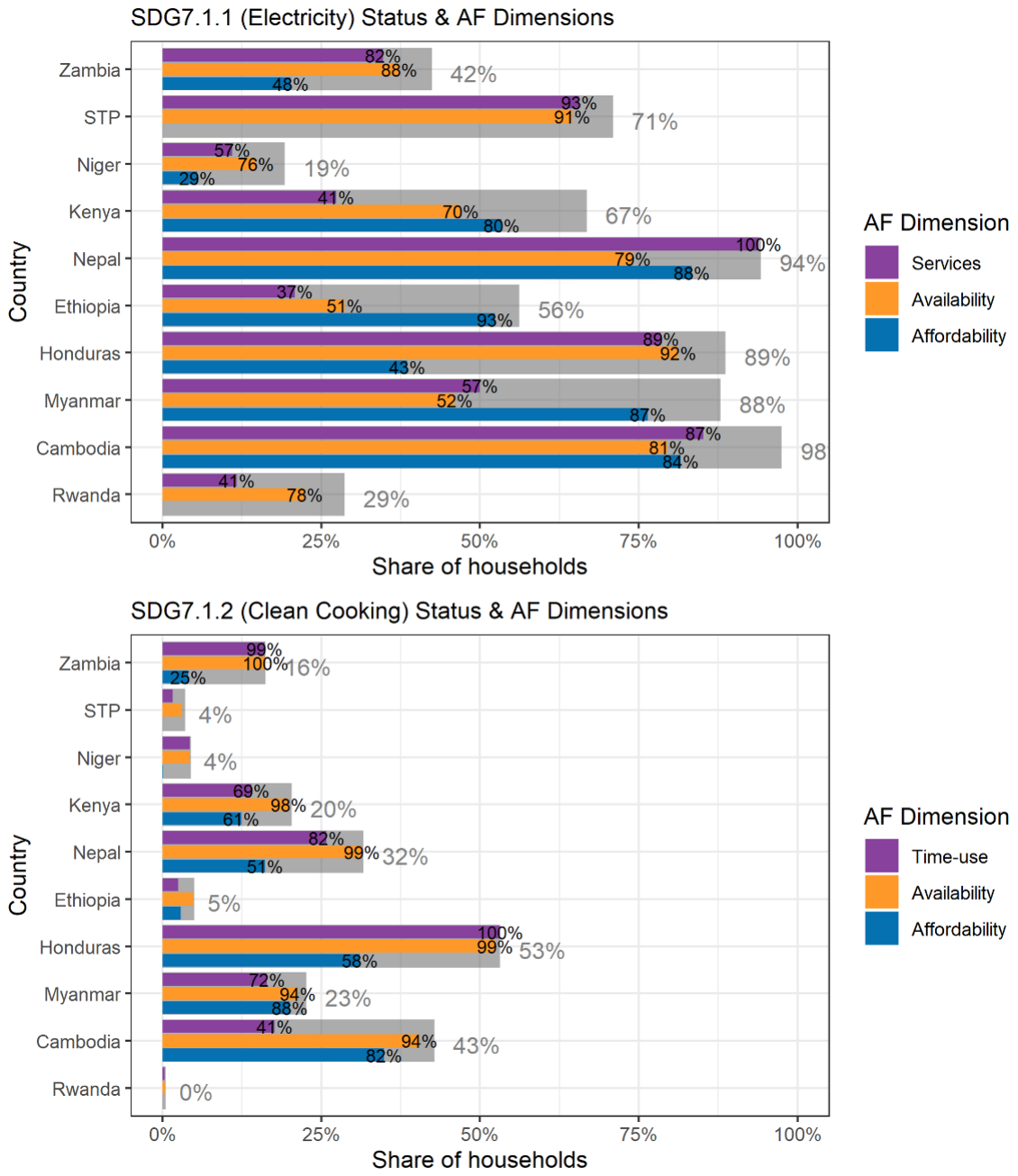
We find that affordability is the most widespread constraint on electricity, with at best 93% in Ethiopia and at worst 29% in Niger of households already counted as having access allocating less than 5% of their annual expenditures to electricity consumption. Utilisation of decent energy services varies most of all, from 100% in Nepal to just 37% in Ethiopia of electrified households, and decent supply availability is provided to at best 92% in Honduras and at worst 51% in Ethiopia.
The clean cooking picture follows the same shape. Affordability again binds hardest, with at best 82% in Cambodia and at worst just 25% in Zambia of households counted as having clean cooking access spending under 5% of annual expenditures on cooking fuels. Stove stacking, meaning continued use of solid-fuel cookstoves despite stating primary reliance on a clean stove, is also evident: between 100% in Honduras and 41% in Cambodia of these households use their clean stove for at least 80% of typical daily cooking time. Wealth predicts satisfying each dimension, and poorer sub-groups are more often provided substandard access.
Narrow indicators reflect narrow ambitions
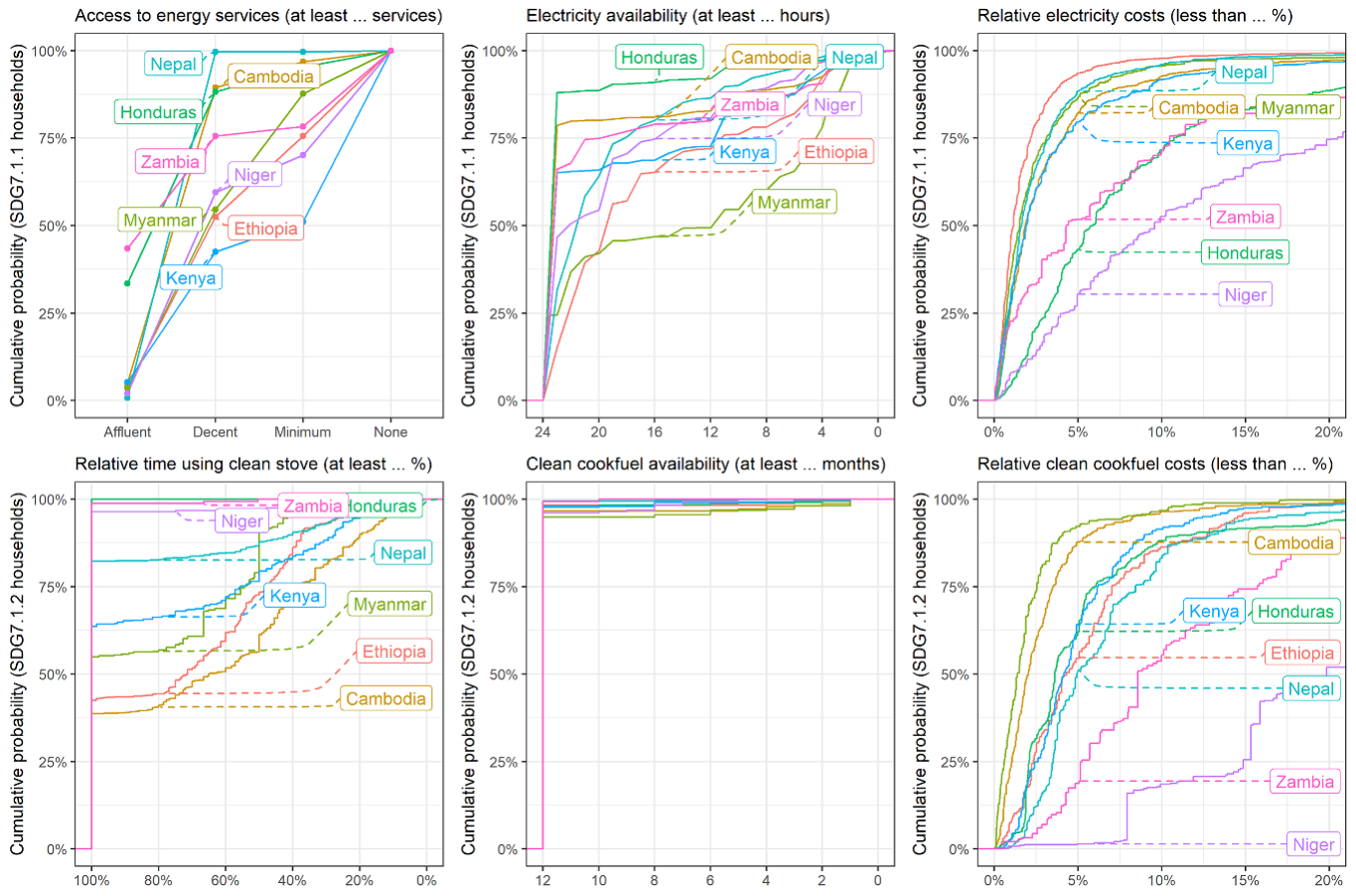
Our application of the alternative framework clearly illustrates that households officially counted as having access to modern energy sources, in many instances, still benefit only from minimal energy services, receive unreliable energy supply, and struggle to afford the energy services they need to enjoy a decent standard of living.
We argue that the narrow indicators used in measuring global progress towards SDG 7.1 reflect narrow ambitions, masking the difficult reality that we are further from the goal of providing affordable, reliable and modern energy for all than is currently reported, and that poorer population sub-groups are more often provided substandard access. The framework is not offered as a replacement metric so much as a demonstration that the existing indicators can be strengthened with measures of actual energy service utilisation and supply quality, which reflect the developmental and well-being improvements that energy access is supposed to unlock. Affordability in particular is poorly reported across existing survey instruments, which is itself a finding for anyone designing the next round of survey instruments.
@article{pelz_application_2021,
	title = {Application of an alternative framework for measuring progress towards {SDG} 7.1},
	volume = {16},
	copyright = {All rights reserved},
	doi = {10.1088/1748-9326/ac16a1},
	number = {8},
	journal = {Environmental Research Letters},
	publisher = {IOP Publishing},
	author = {Pelz, Setu and Pachauri, Shonali and Rao, Narasimha},
	year = {2021},
	pages = {084048},
}