A critical review of modern approaches for multidimensional energy poverty measurement
New multidimensional energy-poverty measures are too complex globally, too prescriptive nationally
Whether multidimensional energy poverty measures can be operationalised
Energy poverty is still tracked globally through binary indicators, recording whether a household has a connection rather than what that connection delivers. The shortcomings are well known, and a set of newer frameworks was developed explicitly to redress them by describing access across multiple dimensions and graded levels.
Building these frameworks and operationalising them are different problems. A measure rich enough to capture what a household can do with its energy supply requires data that most national statistical systems do not collect, and thresholds whose placement encodes contestable judgements about what constitutes adequate service in a given context. We review recent efforts at operationalising multidimensional measures of energy poverty that move beyond the binary indicators currently in use, asking what applying them implies for global tracking on one hand and national policy and planning on the other. Those two purposes pull in opposite directions, and a measure optimised for one tends to fail the other.
How new frameworks define and measure access
We review the Multitier Framework for Measuring Energy Access, the Multidimensional Energy Poverty Index, Total Energy Access, and the Energy Supply Index, situating them against the earlier access-use framework and the Global Tracking Framework under Sustainable Energy for All. We do not attempt a comprehensive review of individual measurement frameworks or metrics, as several recent reviews already exist. Instead we review how the new frameworks define and measure distinct aspects of energy poverty and discuss the challenges arising in their application, focusing particularly on household energy services as the most developed component of existing measures.
Alongside the frameworks themselves we examine their empirical applications, in particular the largest publicly available primary data collection exercise dedicated to measuring energy access with the Multitier Framework, which surveyed 8,566 households across selected Indian states. That application is the clearest available test of whether the framework's resolution survives contact with primary data collection at scale.
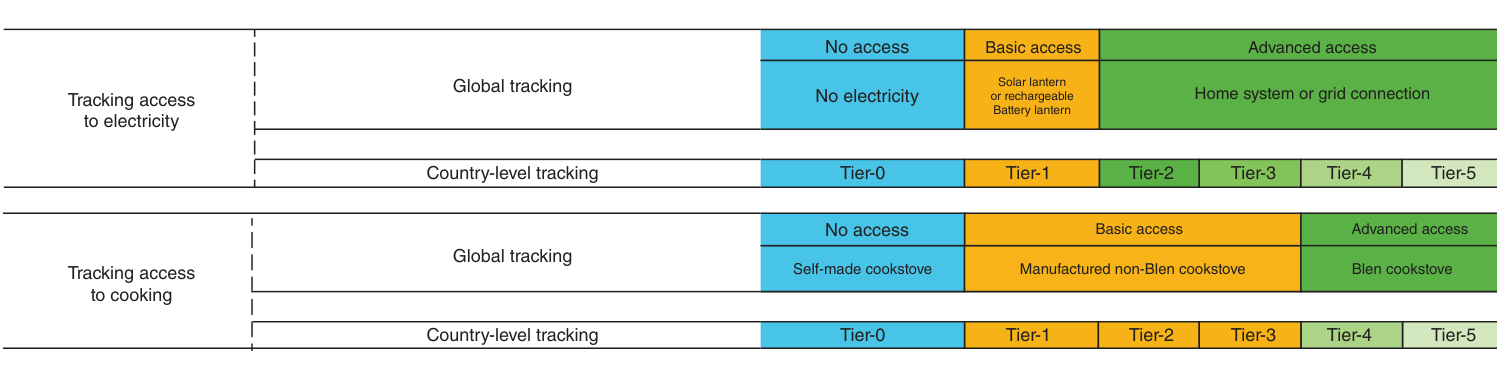
Too complex globally, too prescriptive nationally
Each Multitier Framework matrix, whether for energy supply or for access to a household energy service, provides thresholds for seven dimensions distinguished across six tiers. That resolution creates difficulties in both directions. Its Access Index weights each tier in proportion to its number, so that moving from Tier 0 to Tier 4 is treated as twice as beneficial as moving from Tier 0 to Tier 2, a linearity the framework does not justify. Only the top two tiers are consistent with indoor air quality standards that significantly reduce the health risks of cooking emissions, and affordability is not considered below Tier 3 and only rudimentarily defined above it. The Energy Supply Index similarly mentions quality, intermittency and reliability without explicitly defining them.
The Indian application is instructive on both counts. It concluded that the number of tiers should be reduced to four, since finer differentiation was not considered to add value in that context. It also found that of the households placed in Tier 0, nearly 50% already have an electric grid connection, which demonstrates precisely the inadequacy of connection-based binary metrics that the multidimensional frameworks were built to expose.
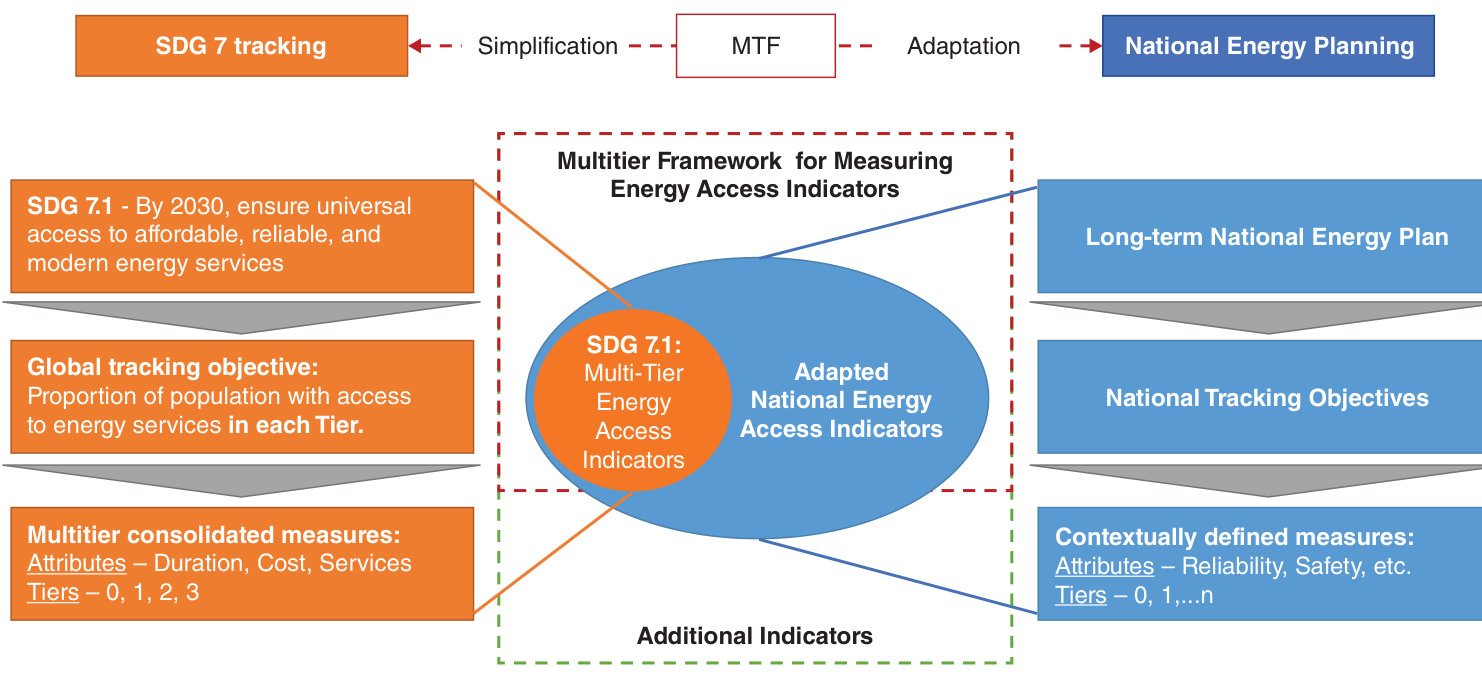
Shortlist globally, adapt thresholds nationally
We find that despite real progress in capturing the multidimensional nature of energy poverty, the new measures are currently too complex to operationalise at the global level and too prescriptive to gain acceptance across diverse national contexts. Substantial challenges remain in both the construction of these frameworks and their application, and treating a single framework as serving both purposes is what generates the tension.
We argue that two parallel efforts are needed. A subset of key energy poverty dimensions and a uniform set of indicators should be shortlisted for the purposes of global comparison, simplified to a standard set of dimensions, thresholds and tiers that each national tracking framework reports in order to ensure international comparability. National energy planners could then have the freedom and the responsibility to develop a suitably complex, politically and socially acceptable national framework based on their own needs, applying the dimensions and thresholds best suited to capture energy poverty and its drivers in a given context, while still reporting the standard dimensions upward.
@article{pelz_critical_2018,
	title = {A critical review of modern approaches for multidimensional energy poverty measurement},
	volume = {7},
	copyright = {All rights reserved},
	doi = {https://doi.org/10.1002/wene.304},
	number = {6},
	journal = {Wiley Interdisciplinary Reviews: Energy and Environment},
	publisher = {Wiley Online Library},
	author = {Pelz, Setu and Pachauri, Shonali and Groh, Sebastian},
	year = {2018},
	pages = {e304},
}