Short-run effects of grid electricity access on rural non-farm entrepreneurship and employment in Ethiopia and Nigeria
Grid access alone did not shift rural non-farm entrepreneurship in Ethiopia or Nigeria
Does grid access shift rural livelihoods
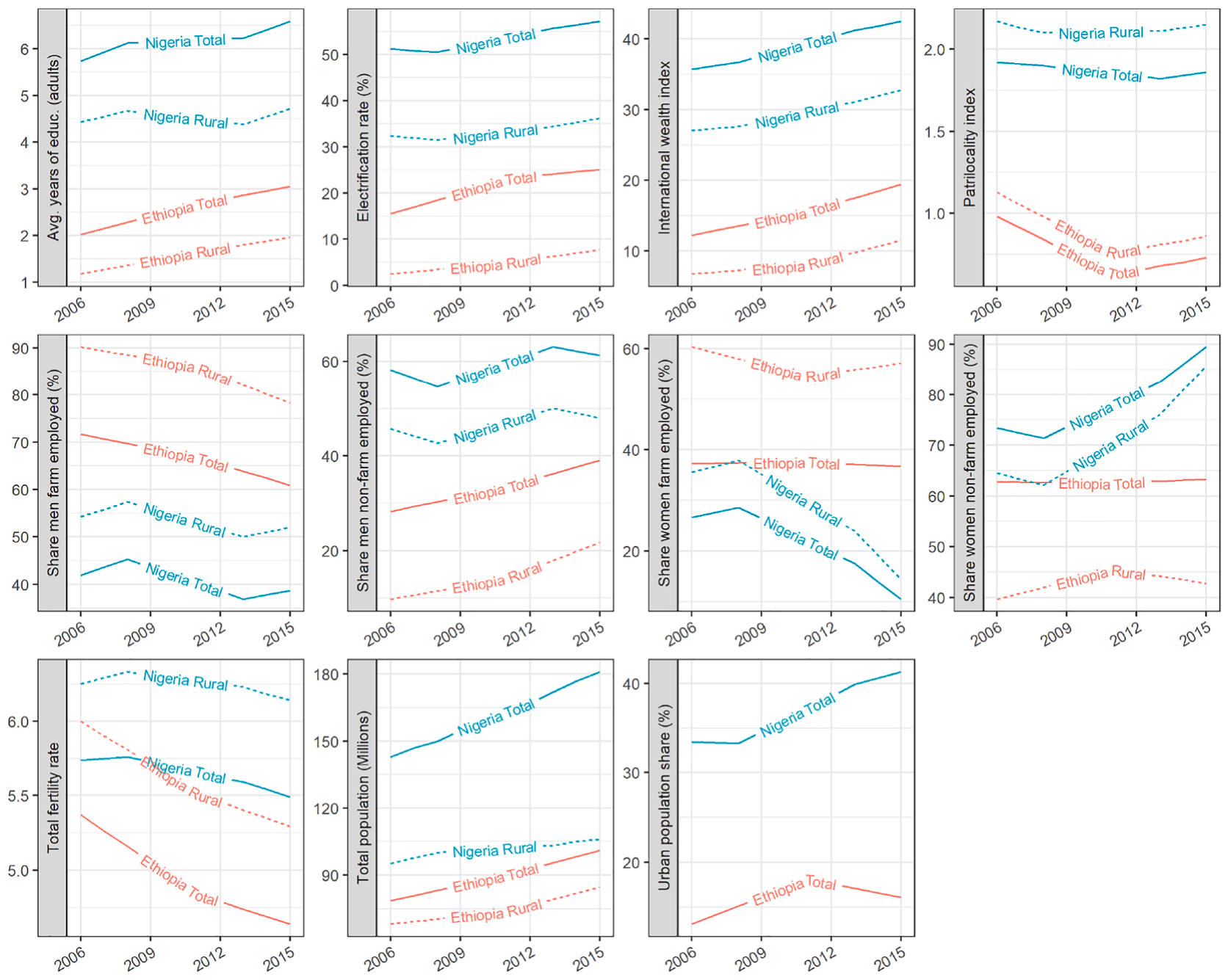
Rural Nigeria and Ethiopia represent major hotspots of energy poverty, hosting 58 and 90 million people without access to electricity respectively, which together sum to almost 20% of the global electricity access gap. In 2015, 36% of the rural population in Nigeria reported having access to the national grid, against only 8% in rural Ethiopia.
Rural electrification programmes in both countries are justified in substantial part by an expected structural shift: that connected households will move away from agricultural livelihoods towards non-farm enterprise and non-farm wage employment. We ask whether gaining access to grid electricity causes that shift in the short run, meaning the two to four years following connection. The question is as much methodological as substantive, because much of the existing evidence rests on identification strategies whose assumptions are difficult to defend, and a finding of no effect is only informative if the design was capable of detecting one.
Doubly robust difference-in-differences on two panels
We use the Nigerian and Ethiopian Living Standards and Measurement Study surveys collected by the World Bank with national statistics agencies across three waves, running 2010, 2012 and 2015 in Nigeria and 2011, 2013 and 2015 in Ethiopia. We retain only households present in all three waves that did not move house, removing those that were always electrified and those with mixed electrification, leaving 2,594 households in Ethiopia of the 3,466 rural households originally surveyed, and 1,920 households under household treatment or 1,650 under community treatment in Nigeria, of 3,356 originally surveyed.
Treatment is household connection to the national grid, and in Nigeria we additionally estimate effects of community connection, which is the arguably more defensible treatment because it is less exposed to household-level selection. We apply the doubly robust difference-in-differences estimator of Sant'Anna and Zhao, extended for staggered treatment timing by Callaway and Sant'Anna, which combines inverse probability weighting with outcome regression so that correctly specifying either stage recovers the true average treatment effect. Identification requires parallel trends conditional on baseline covariates, which include distance to road, market and administrative centre, household size and composition, education, and an asset index.
A precisely framed null in both countries
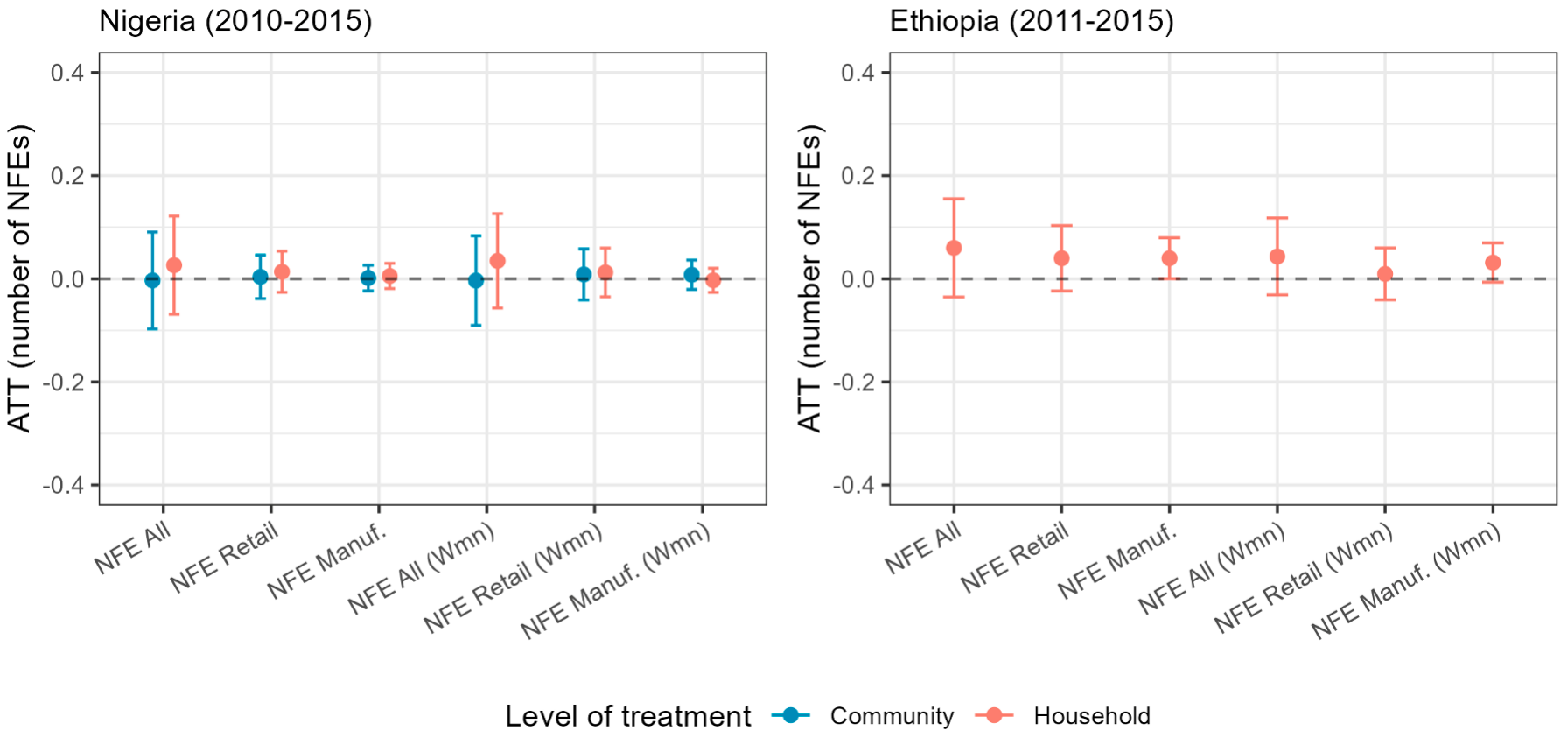
Our results indicate that rural electrification considered alone was insufficient to trigger shifts in non-farm entrepreneurship and non-farm household employment outcomes in the two to four years following grid connection in either country. The coefficients for the average change in the number of non-farm enterprises operated by households following electrification are generally not statistically significant at a 95% level of confidence, meaning we are unable to identify a treatment effect distinct from what we would expect under normal sampling variation. This holds at the household level and at the community level in Nigeria, and at the household level in Ethiopia, and heterogeneity across different types of non-farm enterprise and those co-owned by women household members is not evident.
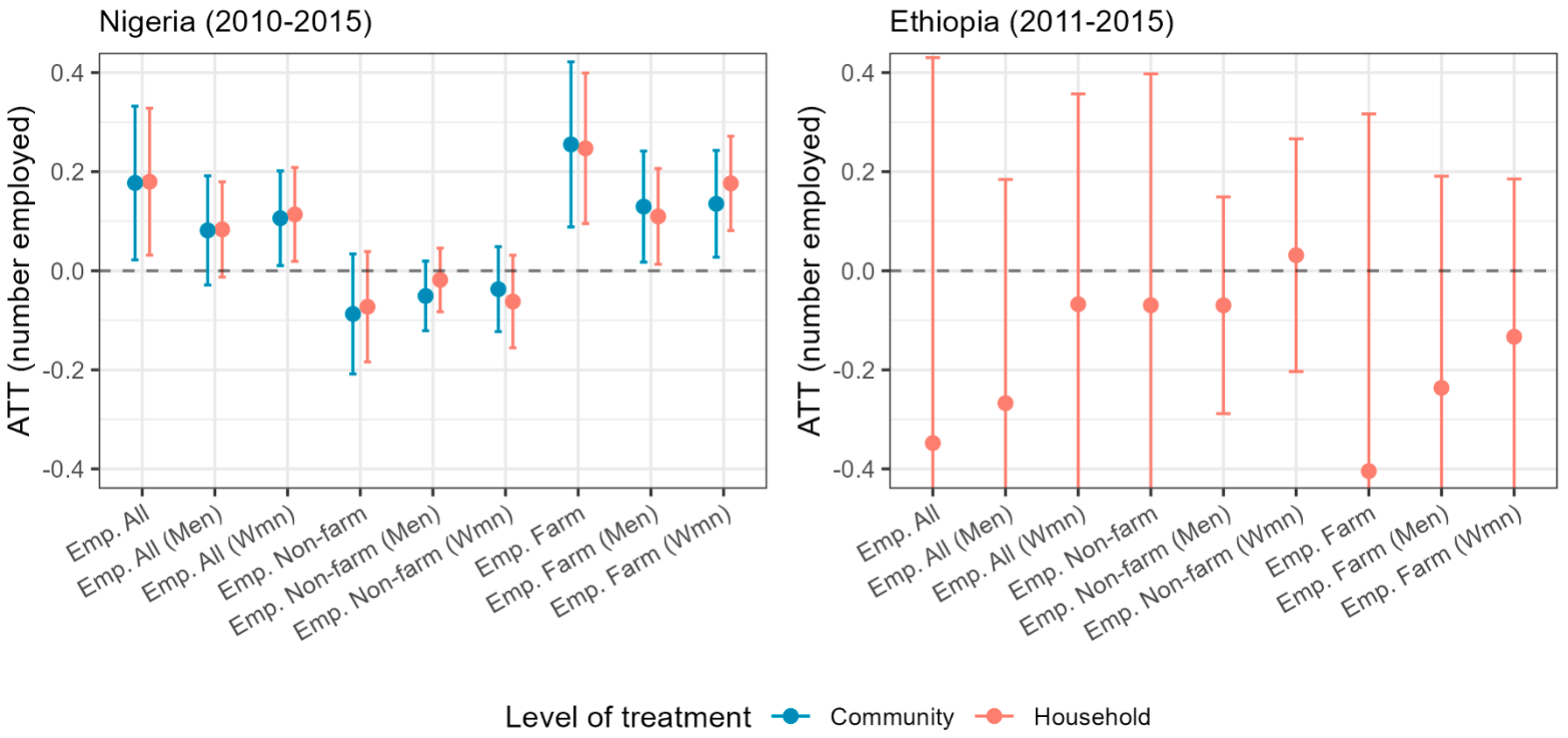
On employment we find some evidence of a positive shift in Nigeria among both male and female household adults, alongside what appears to be a movement away from non-farm employment, which is not statistically significant, and towards farm employment, which is. None of this is evident in Ethiopia, where error bars are much wider, likely attributable to high rates of farm-based self-employment. We note that our treatment groups are small relative to the control groups, which may leave insufficient statistical power.
Justify electrification by capabilities, not short-run returns
Our analysis of the rural Nigerian sample provides contrary evidence to recent work using the same dataset, which identified a positive association between electrification and shifts towards non-farm employment using instrumental variable regression and matching. Our work is not a replication and was conceived independently, but the divergence indicates how strongly the identification strategy determines the result. These findings align with a contemporary literature urging caution in drawing inference from potentially biased strategies that cannot reliably extract the desired causal estimand.
We speculate that structural economic impacts of electrification should be evaluated over longer periods, to improve identification of the causal effects of access and its relationship with complementary infrastructure and capacity, which can take substantial time to develop. We close with a caution. A strict economic cost-benefit analysis informed by studies such as ours might conclude that rural electrification is not worthwhile in remote areas, and that would be a limited uni-dimensional perspective. We argue that designing electrification policy around expected short-term economic shifts will likely disappoint policy makers and may increase inequity, and that infrastructure provision should instead be embedded in frameworks of human well-being such as Decent Living Standards.
@article{pelz_short-run_2023,
	title = {Short-run effects of grid electricity access on rural non-farm entrepreneurship and employment in {Ethiopia} and {Nigeria}},
	volume = {29},
	copyright = {All rights reserved},
	issn = {24522929},
	url = {https://linkinghub.elsevier.com/retrieve/pii/S2452292922000819},
	doi = {10.1016/j.wdp.2022.100473},
	language = {en},
	urldate = {2022-12-09},
	journal = {World Development Perspectives},
	author = {Pelz, Setu and Pachauri, Shonali and Falchetta, Giacomo},
	month = mar,
	year = {2023},
	pages = {100473},
}