A principle-based framework to determine countries' fair warming contributions to the Paris Agreement
We allocate an all-greenhouse-gas warming budget to countries using international-law principles
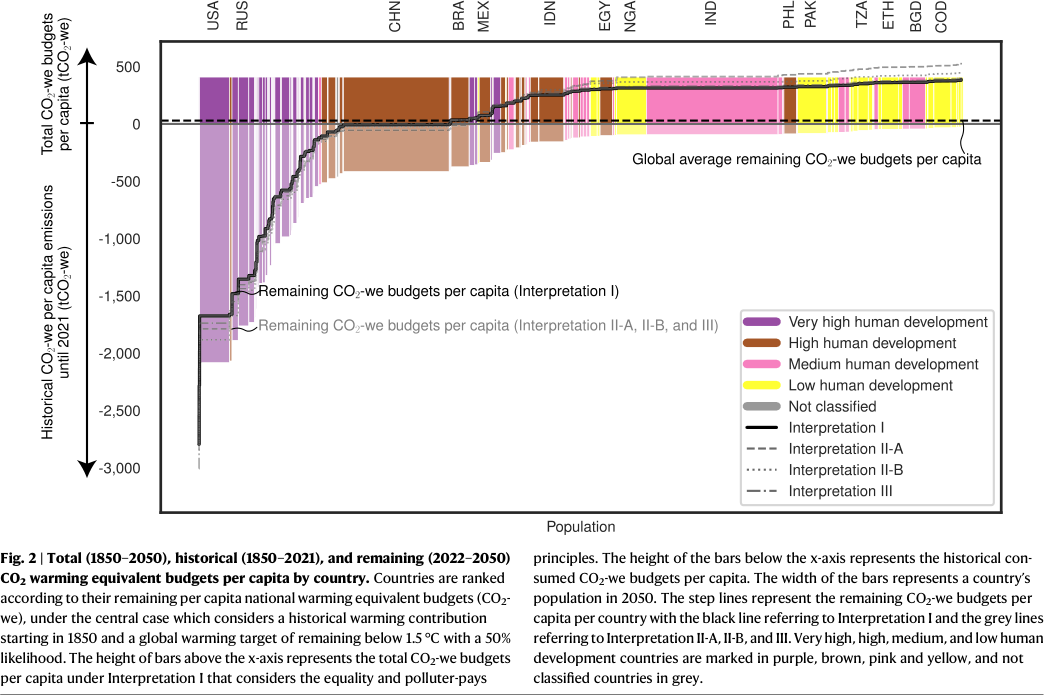
We define a global warming budget covering all anthropogenic greenhouse gases, closing a gap in prior effort-sharing work that did not properly account for non-CO2 warming, and allocate it to countries using equity principles drawn from international treaties and environmental law. We find that by 2021, between 84 and 90 countries, including but not limited to all major developed countries, had already exhausted their budget share compatible with keeping warming to 1.5C at 50% likelihood, under every allocation approach considered. A similar picture emerges for 2C at 67% likelihood.
This 'fair share' overshoot holds even if countries' Paris Agreement pledges represent their deepest possible domestic emission reductions. Because so many countries have already exceeded their fair budget at home, we argue that considerations of fairness must start to explore aspects beyond domestic emission reductions.
@article{li_principle-based_2025,
	title = {A principle-based framework to determine countries’ fair warming contributions to the {Paris} {Agreement}},
	volume = {16},
	copyright = {All rights reserved},
	issn = {2041-1723},
	url = {https://www.nature.com/articles/s41467-025-56397-6},
	doi = {10.1038/s41467-025-56397-6},
	abstract = {Abstract

              Equity is a cornerstone of global climate policy, yet differing perspectives mean that international agreement on how to allocate mitigation efforts remains elusive. A rich literature informs this question, but a gap remains in approaches that appropriately consider non-CO
              2
              emissions and their warming contributions. In this study, we address this gap and define a global warming budget applicable to all anthropogenic greenhouse gases that is allocated to countries based on principles drawn from international treaties and environmental law. We find that by 2021 a range of 84 to 90 countries, including but not limited to all major developed countries, exhausted their budget share compatible with keeping warming to 1.5 °C (with 50\% likelihood) under all allocation approaches considered in this study. A similar picture emerges for limiting warming to 2 °C (with 67\% likelihood). A large group of countries will hence exceed their fair shares even if their pledges under the Paris Agreement represent their deepest possible emission reductions. Considerations of fairness should therefore start exploring aspects beyond domestic emissions reductions.},
	language = {en},
	number = {1},
	urldate = {2025-01-30},
	journal = {Nature Communications},
	author = {Li, Mingyu and Pelz, Setu and Lamboll, Robin and Wang, Can and Rogelj, Joeri},
	month = jan,
	year = {2025},
	pages = {1043},
}