High-income groups disproportionately contribute to climate extremes worldwide
Wealthiest 10% drove two-thirds of warming since 1990
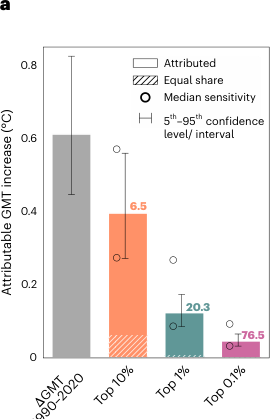
We link emissions inequality over 1990–2020 to regional climate extremes using an emulator-based framework. We find that two-thirds of warming is attributable to the wealthiest 10%, and one-fifth to the top 1%. Individual contributions are 6.5 and 20 times the average per capita. The frame here is the affluent emitter, not the national average.
These disparities carry through to extremes. The top 10% (1%) contributed 7 (26) times the average to increases in monthly 1-in-100-year heat extremes globally, and 6 (17) times more to Amazon droughts. Emissions from the wealthiest 10% in the United States and China alone led to a two- to threefold increase in heat extremes across vulnerable regions.
We argue this shifts the responsibility frame. National totals obscure how emissions concentrate among high-income groups; attributing extremes to emitter affluence makes that concentration visible and assignable. Quantifying the link between wealth disparities and climate impacts is associated with a more transparent basis for 'fair shares' debates that anchor on country aggregates and understate within-country inequality.
@article{schongart_high-income_2025,
	title = {High-income groups disproportionately contribute to climate extremes worldwide},
	volume = {15},
	copyright = {All rights reserved},
	issn = {1758-678X, 1758-6798},
	url = {https://www.nature.com/articles/s41558-025-02325-x},
	doi = {10.1038/s41558-025-02325-x},
	abstract = {Abstract
            Climate injustice persists as those least responsible often bear the greatest impacts, both between and within countries. Here we show how GHG emissions from consumption and investments attributable to the wealthiest population groups have disproportionately influenced present-day climate change. We link emissions inequality over the period 1990–2020 to regional climate extremes using an emulator-based framework. We find that two-thirds (one-fifth) of warming is attributable to the wealthiest 10\% (1\%), meaning that individual contributions are 6.5 (20) times the average per capita contribution. For extreme events, the top 10\% (1\%) contributed 7 (26) times the average to increases in monthly 1-in-100-year heat extremes globally and 6 (17) times more to Amazon droughts. Emissions from the wealthiest 10\% in the United States and China led to a two- to threefold increase in heat extremes across vulnerable regions. Quantifying the link between wealth disparities and climate impacts can assist in the discourse on climate equity and justice.},
	language = {en},
	number = {6},
	urldate = {2026-01-13},
	journal = {Nature Climate Change},
	author = {Schöngart, Sarah and Nicholls, Zebedee and Hoffmann, Roman and Pelz, Setu and Schleussner, Carl-Friedrich},
	month = jun,
	year = {2025},
	pages = {627--633},
}