The spatial and economic footprint of the coal industry on rural livelihoods in Jharkhand, India

S Pelz, A Krumm, M Aklin, V Nandan, J Urpelainen · Energy Policy · 2024

Coal livelihoods concentrate within 5 km of mines, atop pervasive informal casual labour
01 · The question

How far coal dependence extends from mines

Just transition policy in India's coal-producing states has to be designed around a population whose dependence on the sector is poorly characterised. Formal employment figures capture those on colliery payrolls, but rural economies around active mines also sustain contractors, transporters, traders and casual labourers whose incomes move with the mine without appearing in any employment register.

We ask two questions. First, what sources of livelihoods are relied upon in rural villages proximate to coal mines in Jharkhand? Second, how does coal-related livelihood dependence manifest at different distances from these mines? The spatial framing matters for policy design: a transition support programme sized to a district looks very different from one sized to a five-kilometre radius, and the choice between them should rest on where dependence actually sits. Getting the scale wrong is costly in either direction: too narrow and dependent households fall outside eligibility, too broad and support disperses to households the mine never sustained.

02 · Approach

Two thousand households across three distance bands

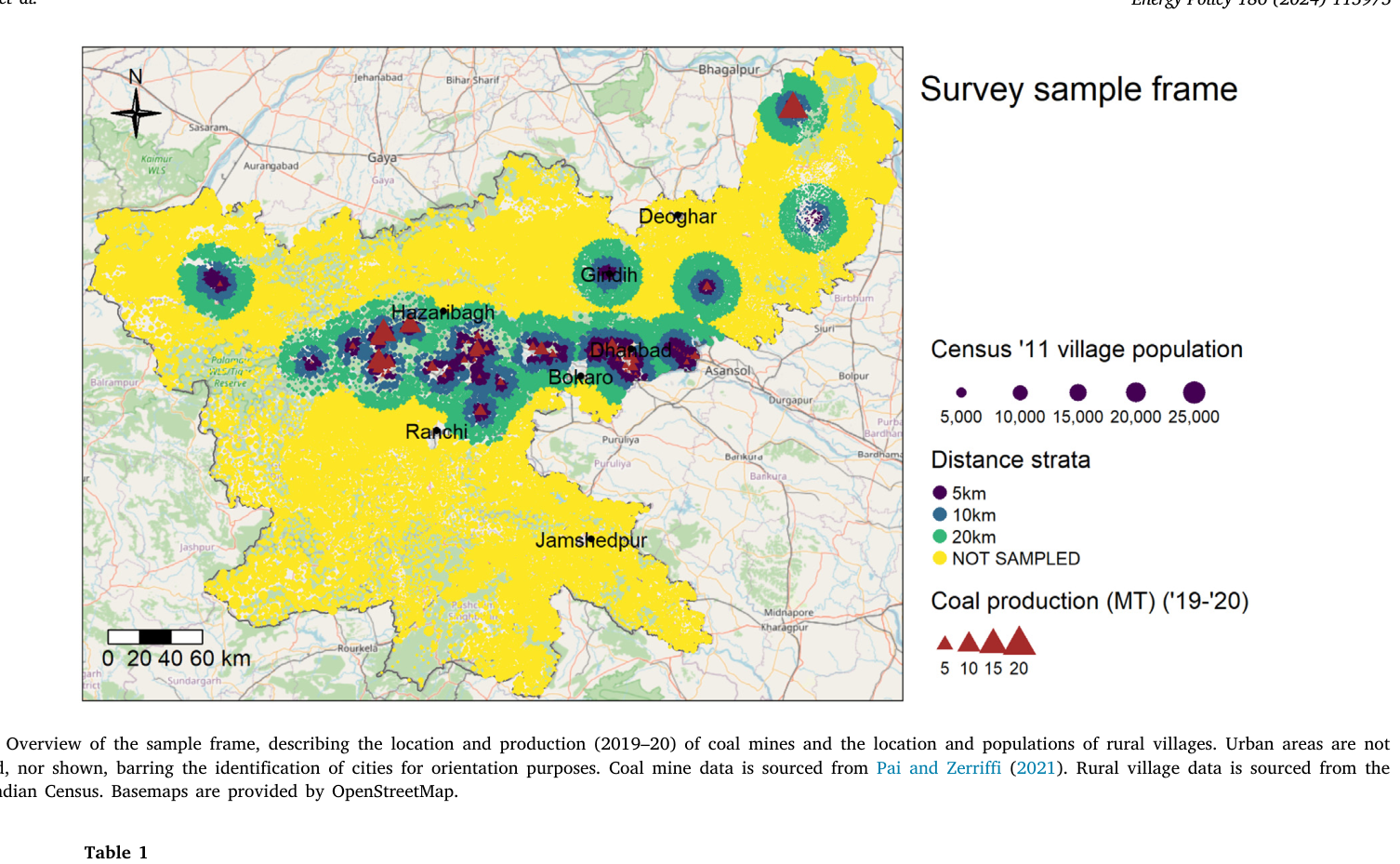
We survey 2,000 rural households in Jharkhand by telephone, with fieldwork conducted during the COVID-19 pandemic. The sample is spatially stratified and self-weighted across three distance bands from currently operating coal mines, within 5 km, 5 to 10 km, and 10 to 20 km, giving 670 households from 67 villages per stratum. Villages are further sub-stratified by proximate production and selected with probability proportionate to size using 2011 census village populations, with ten households interviewed per village drawn from Election Commission voter registration lists.

The mine frame comprises 114 operating mines, across which median production was approximately 0.3 megatonnes in 2019-20. Combining the spatial mine data with the 2011 census, approximately 25% of rural villages in Jharkhand lie within 20 km of an active mine, 9% within 10 km and 3% within 5 km; in population terms roughly 28% of the state's rural population lives within 20 km and 5% within 5 km. We rely on descriptive aggregates across the distance strata rather than a regression design.

Overview of the sample frame, describing the location and production (2019-20) of coal mines and the location and populations of rural villages. Basemaps are provided by OpenStreetMap. CC-BY 4.0.
03 · Findings

Narrow direct dependence, pervasive informal reliance

We find that direct coal dependence is sharply concentrated near mines. Approximately 11% of surveyed households within 5 km of an active mine state that their primary income is derived directly from the coal sector, which reduces to approximately 2% within 5 to 10 km and less than 1% within 10 to 20 km. Across every distance band, approximately half of households rely primarily on casual labour incomes.

Perceived importance tells a different story from measured income. Approximately 72% of respondents within 5 km perceive coal to be an important sector for village livelihoods, dropping to just over 23% in the 10 to 20 km band, the largest shift in perceived importance of any sector in the survey and larger even than the shift for agriculture. Just under half of those not reporting work in the coal sector nonetheless believe it is important for their household livelihoods, which suggests that widespread informality masks reliance the income data does not capture. Trust in the coal company to improve local livelihoods is far lower than trust in the state government, and approximately 80% of households consider it important that new job investments occur now and in nearby villages rather than the state capital.

Reported direct dependence on the coal industry for primary household incomes. CC-BY 4.0.
11%
Households within 5 km of an active mine reporting coal as their primary income, against under 1% beyond 10 km
72% to 23%
Share perceiving coal as important for village livelihoods, from within 5 km to the 10-20 km band
04 · Why it matters

Target sharply, then catch the informal majority

A tightly concentrated spatial footprint layered with pervasive employment informality carries two distinct policy implications, and conflating them would fail one group or the other. Specific just transition interventions addressing formal and informal coal employment must be targeted sharply around active coal mines, within approximately 5 km, where the skills concentration and the prospective employment deficit both sit.

At the same time, the large informal sector necessitates broader policies targeting casual labour, so that those most vulnerable are not left behind by energy system transitions that may have ripple effects in secondary and tertiary sectors. We argue that recognising the spatial footprint of the coal industry, and the corresponding employment deficits, is a precondition for rural economic diversification that can compensate for mine closures. Who delivers that support also matters, given that respondents place greater confidence in the state than in the coal company to improve local livelihoods.

Village livelihoods and the perceived importance of the coal industry. CC-BY 4.0.
Cite
@article{pelz_spatial_2024,
	title = {The spatial and economic footprint of the coal industry on rural livelihoods in {Jharkhand}, {India}},
	volume = {186},
	copyright = {All rights reserved},
	issn = {03014215},
	url = {https://linkinghub.elsevier.com/retrieve/pii/S030142152300558X},
	doi = {10.1016/j.enpol.2023.113973},
	language = {en},
	urldate = {2024-01-28},
	journal = {Energy Policy},
	author = {Pelz, Setu and Krumm, Alexandra and Aklin, Michaƫl and Nandan, Vagisha and Urpelainen, Johannes},
	month = mar,
	year = {2024},
	pages = {113973},
}