Understanding land-based carbon dioxide removal in the context of the Rio Conventions
A framework aligning land-based CDR with the three Rio Conventions
What 'nature-based' labels hide about removals
Carbon dioxide removal is increasingly treated as essential to the Paris Agreement's climate goals, and current strategies lean primarily on land-based measures: afforestation, reforestation, and soil carbon enhancement. These are commonly labelled 'nature-based solutions' or 'natural climate solutions'.
The labels carry substantial implications. They carry an implication that the activity is benign for ecosystems, when the underlying measures range from restoring degraded ecosystems to establishing plantations in non-forested biomes, and differ sharply in their consequences for biodiversity and in the durability of the carbon they hold. The lack of an ecological lens in some forest definitions, which count land with more than 10% tree cover, is itself a contributing factor to forest expansion in non-forested biomes. We ask what constraints follow once land-based removal is evaluated against the objectives the international community has already agreed, rather than against carbon accounting alone. The two framings license very different decisions about which land is planted, with what, and at whose expense.
Ecosystem integrity within Rio Convention guardrails
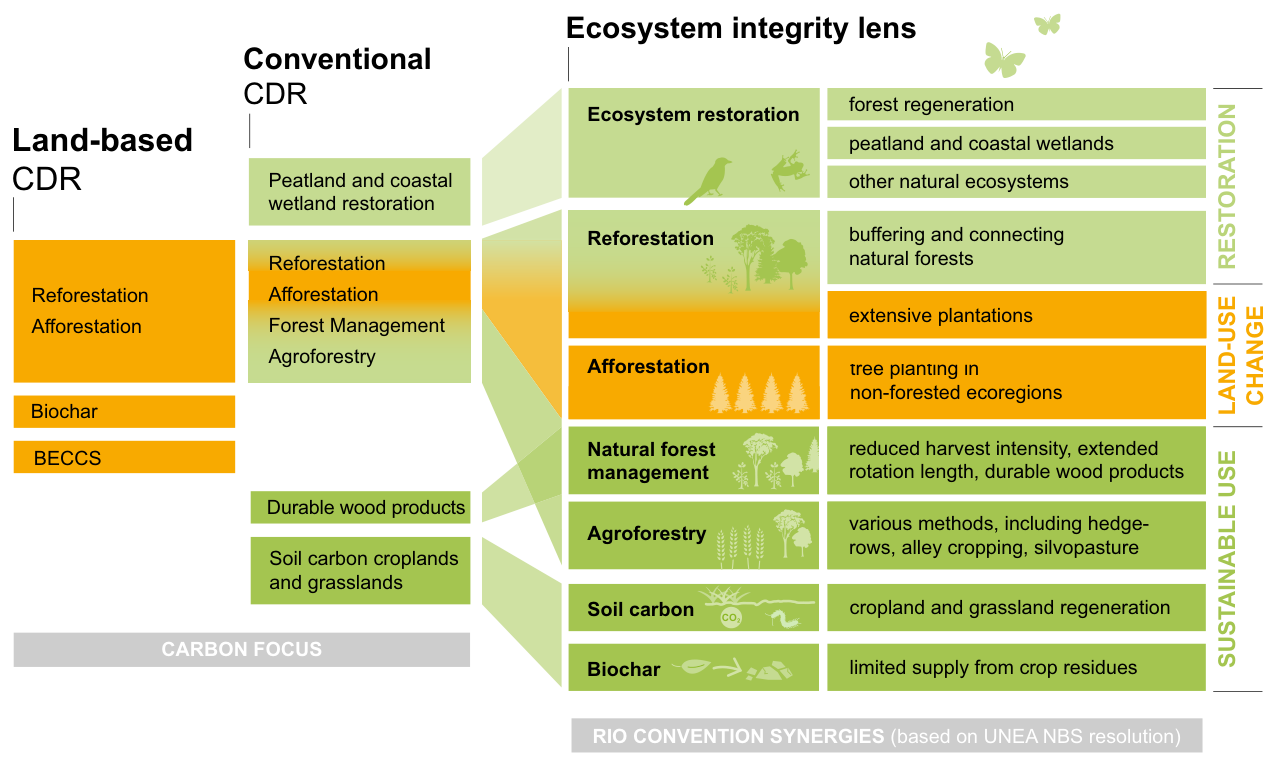
We build a framework for evaluating trade-offs in land-based removal on the definition of nature-based solutions agreed at the fifth session of the United Nations Environment Assembly in 2022, which requires that such solutions deliver human well-being, ecosystem services, resilience and biodiversity benefits while respecting social and environmental safeguards in line with the three Rio Conventions.
Those conventions, all established at the Rio Earth Summit in 1992, are the United Nations Framework Convention on Climate Change, the Convention on Biological Diversity, and the Convention to Combat Desertification. We map their objectives against ecosystem integrity, which encompasses biodiversity, ecosystem structure, processes and stability. The framework has two parts. An ecosystem integrity lens differentiates removal activities into restoration, sustainable use, and land-use change, the last being more likely to cause degradation and to raise the risk of carbon loss. A set of guardrails is derived by extracting 77 instances of potential benefits and safeguards from the three conventions, which we code into nine safeguard types across environmental, social and rights categories. We then apply the framework to recent quantified estimates of removal potential.
Cost and ecology both reduce the potential
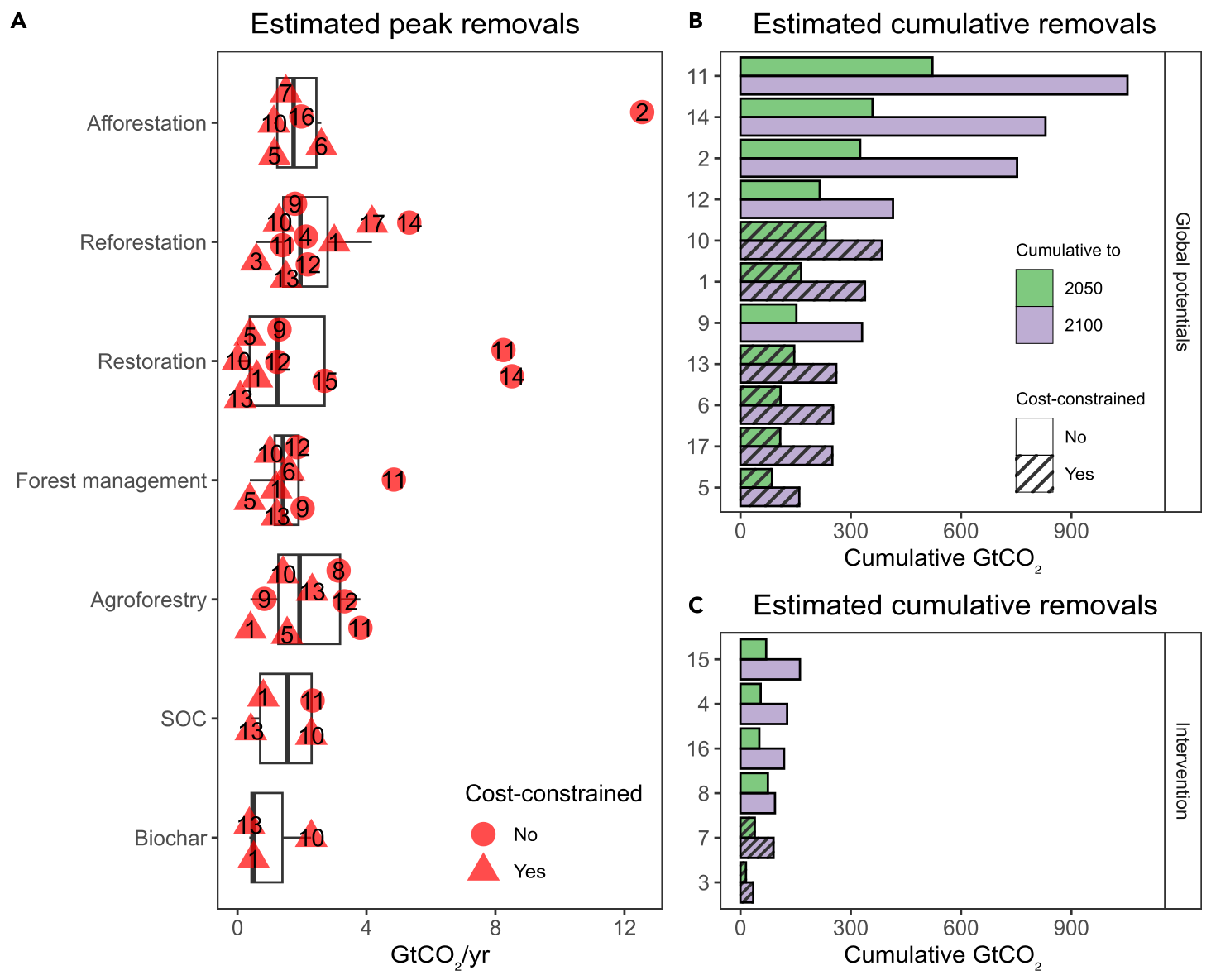
Across global studies we observe a cumulative range of 57 to 1,052 GtCO2 from 2020 to 2100, which, once cost-effectiveness considerations are included, reduces to 57 to 385 GtCO2. The technical potential of allowing forests and other ecosystems to recover to their natural carbon carrying capacity is large, estimated to peak at up to 8.5 GtCO2 per year, but the distinction between afforestation and reforestation is not consistently drawn in the literature. Excluding estimates that are or could be afforestation constrains reforestation to a maximum of 5 GtCO2 per year against 12 GtCO2 per year for afforestation, and cost-effective reforestation potentials are further constrained to 1.2 to 1.5 GtCO2 per year.
Government climate pledges for 2050 include removals of up to 5.0 GtCO2 per year, the majority conventional land-based removal, implying demand for an additional 990 million hectares of land, of which 479 million hectares is for afforestation and reforestation. Safeguards interpreted in the context of the Rio Conventions are inadequately represented in this literature: only one paper in our sample referenced human rights.
Co-benefits first, sequestration second
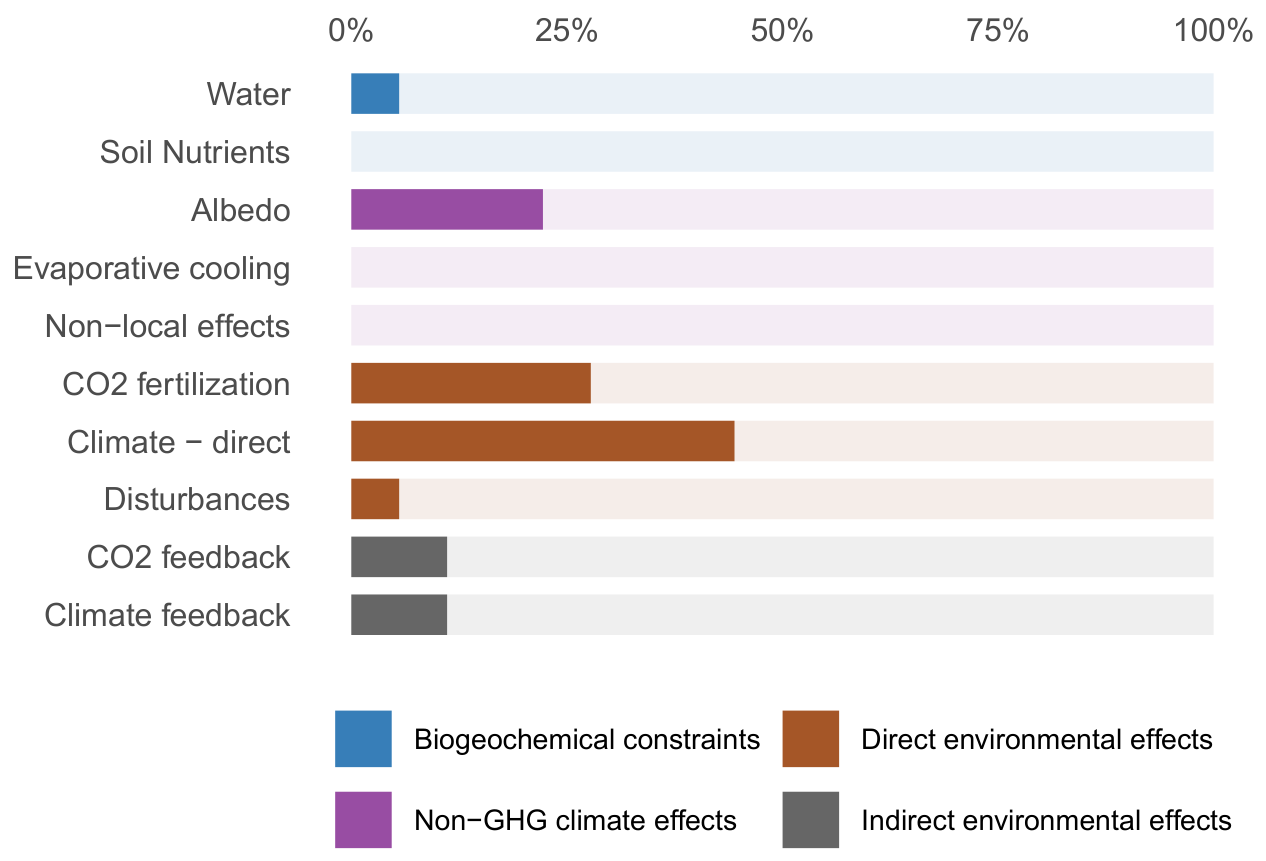
Viewing removal through an ecosystem integrity lens indicates that nature-based approaches should be implemented for their broader co-benefits and not primarily for their carbon sequestration values. Attention to human rights and the rights of Indigenous peoples is a critical gap in the pathways currently proposed, and one that the Rio Conventions themselves have increasingly recognised even as the removal literature has not.
A point reiterated across several of the studies we review is that the climate mitigation benefits of conventional removal accrue only when it is additional to, and not instead of, emission reductions. We argue that climate mitigation through land-based removals should not be pursued at the expense of biodiversity, ecosystem services, or human well-being, and that the Rio Conventions together provide a guardrail for feasible and equitable implementation. Removal that degrades ecosystems in order to sequester carbon undermines the objectives it is invoked to serve.
@article{dooley_understanding_2024,
	title = {Understanding land-based carbon dioxide removal in the context of the {Rio} {Conventions}},
	volume = {7},
	copyright = {All rights reserved},
	issn = {25903322},
	url = {https://linkinghub.elsevier.com/retrieve/pii/S2590332224004196},
	doi = {10.1016/j.oneear.2024.08.009},
	abstract = {Carbon dioxide removal (CDR) is increasingly recognized as essential for achieving the Paris Agreement’s climate goals. Current CDR strategies primarily involve land-based measures, such as afforestation, reforestation, and soil carbon enhancement. These approaches, often labeled as nature-based solutions (NBS) or natural climate solutions (NCS), have sparked debate due to their potential adverse effects on biodiversity and uncertainty around the scale and durability of potential climate benefits. This paper introduces a framework for evaluating trade-offs in land-based CDR activities following the recent United Nations Environment Assembly definition of NBS. This framework emphasizes ecosystem integrity, human rights, and sustainable development, aligning with the objectives of the three Rio Conventions, which provide a guardrail to inform pathways toward feasible and equitable implementation. By applying this framework, we provide a more comprehensive understanding of the environmental and social constraints on CDR, ensuring that climate mitigation efforts do not compromise biodiversity, ecosystem services, or human well-being.},
	language = {en},
	number = {9},
	urldate = {2024-09-23},
	journal = {One Earth},
	author = {Dooley, Kate and Pelz, Setu and Norton, Alexander},
	month = sep,
	year = {2024},
	pages = {1501--1514},
}