Energy access for marginalized communities: Evidence from rural North India, 2015–2018
India's reforms narrowed caste-group gaps in LPG connections but left supply-quality inequities intact
How equitable was India's energy access surge
Rural energy access in India improved substantially across the 2010s through national reforms expanding grid electricity and LPG connections. Headline progress on connection rates is well documented and frequently cited as a development success.
Considering the historical caste-based energy access disparities unique to the Indian context, we ask how equitable those recent improvements have been. The question has two parts that are easy to conflate. Whether historically marginalized households closed the gap in obtaining a connection is one matter; whether the supply arriving through that connection is comparable in quality is another, and government reporting of household energy access is built almost entirely on the first. If reforms equalised connections while leaving supply differentiated, a binary statistic would record the reform as an unambiguous equity success while the lived difference persisted. Separating the two requires measuring the quality of what arrives through a connection, rather than recording only that a connection exists.
Panel data with caste-year interaction terms
We use the Access to Clean Cooking Energy and Electricity Survey of States, a two-wave panel representative of rural areas in six of India's poorest states: Uttar Pradesh, Bihar, West Bengal, Jharkhand, Odisha and Madhya Pradesh. The first wave surveyed 8,563 households across 714 villages in 2015 and the second 9,071 households across 756 villages in 2018, with village-level sampling weights applied throughout.
We apply a linear regression with caste and year interactions, where the interaction between a Scheduled Caste or Scheduled Tribe indicator and the 2018 wave is the coefficient of interest, quantifying how much the change over the period differed for historically marginalized households relative to all others. Village fixed effects with standard errors clustered at village level and household fixed effects clustered at household level are run as parallel specifications, with controls for monthly expenditure, poverty-card status, education, household size, and respondent age, gender and religion. Eight outcomes are modelled, spanning LPG and grid connection, home delivery, daily and evening supply hours, outage days, and days of low and fluctuating voltage. A parallel specification substitutes a Below Poverty Line indicator to test the policies' stated target group.
Connections converged, supply quality did not
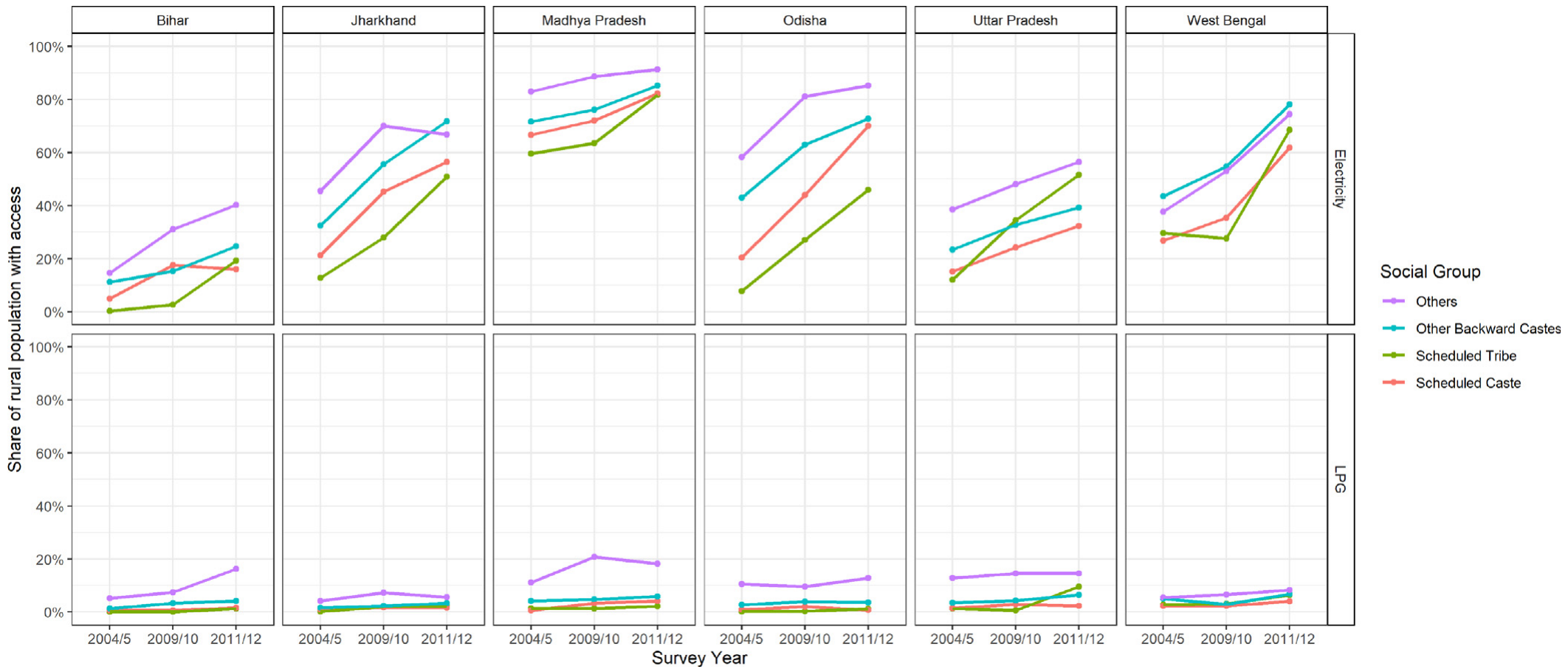
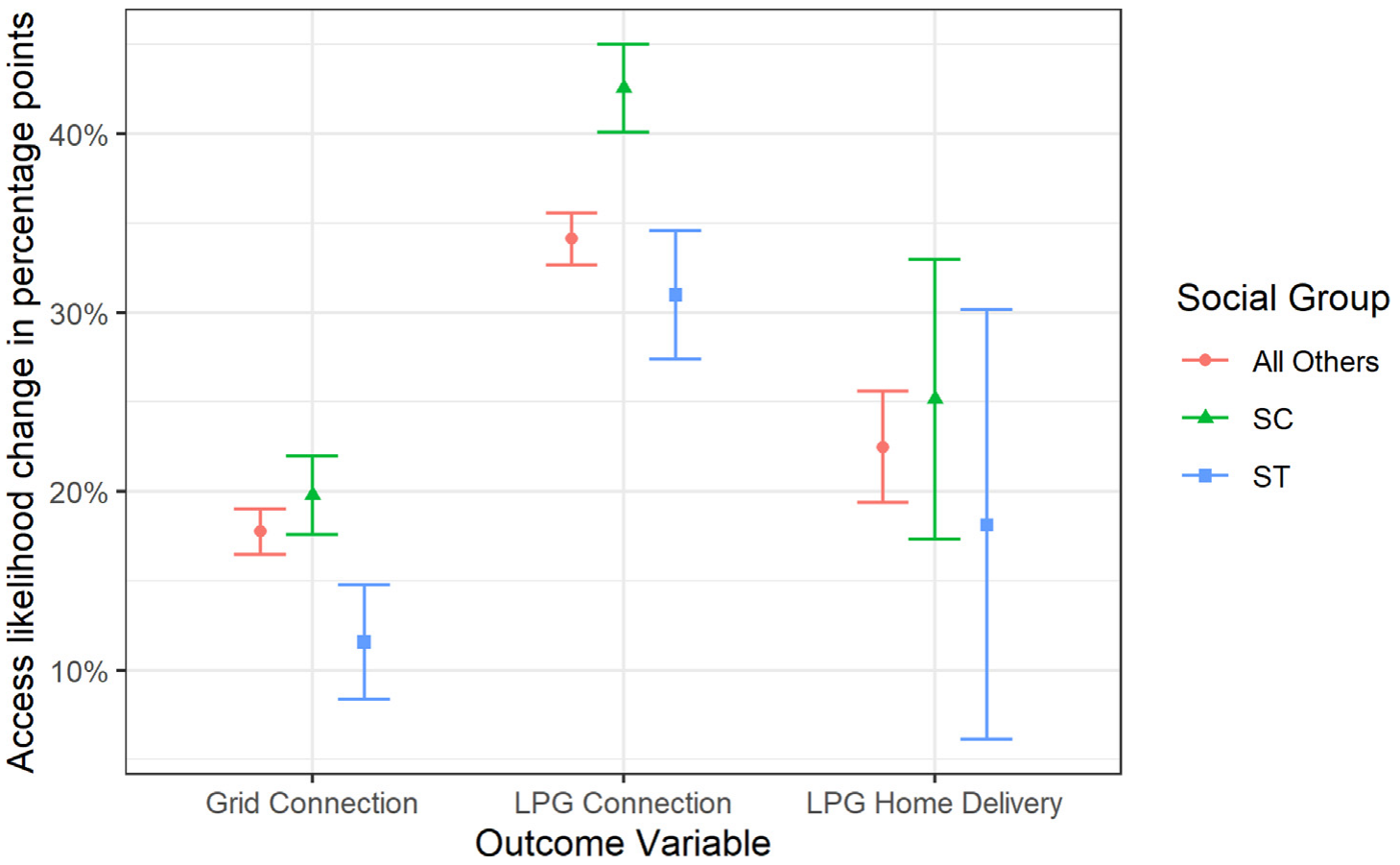
We find that inequities in an SC/ST household's likelihood of obtaining an LPG connection reduced by 4.6 percentage points [95% CI: 0.7 to 7.7], while inequities in grid connection likelihoods remained consistent, with the interaction small and statistically insignificant against an improvement of 17.5 percentage points [CI: 16.4 to 19.2] among all others.
Looking beyond binary connection rates, SC/ST supply improved less across almost every attribute. Daily supply hours improved less by 1.42 hours [CI: 1 to 1.83] and evening supply hours by 0.26 hours [CI: 0.14 to 0.38]. The mean reduction in monthly outage days was smaller by 1 day [CI: 0.7 to 1.3] and in low-voltage days by 0.63 days [CI: 0.05 to 1.2]. One outcome runs in the opposite direction: the reduction in fluctuating-voltage days was larger for SC/ST households by 0.27 days [CI: 0.01 to 0.52]. Substituting poverty status for caste reverses the pattern, with gaps narrowing for both LPG connection, by 11.8 percentage points [CI: 9.7 to 14.9], and grid connection, by 7 percentage points [CI: 4.2 to 9.7], which suggests the reforms reached their stated economic target group more effectively than they reached the caste dimension.
Binary connection statistics obscure supply inequity
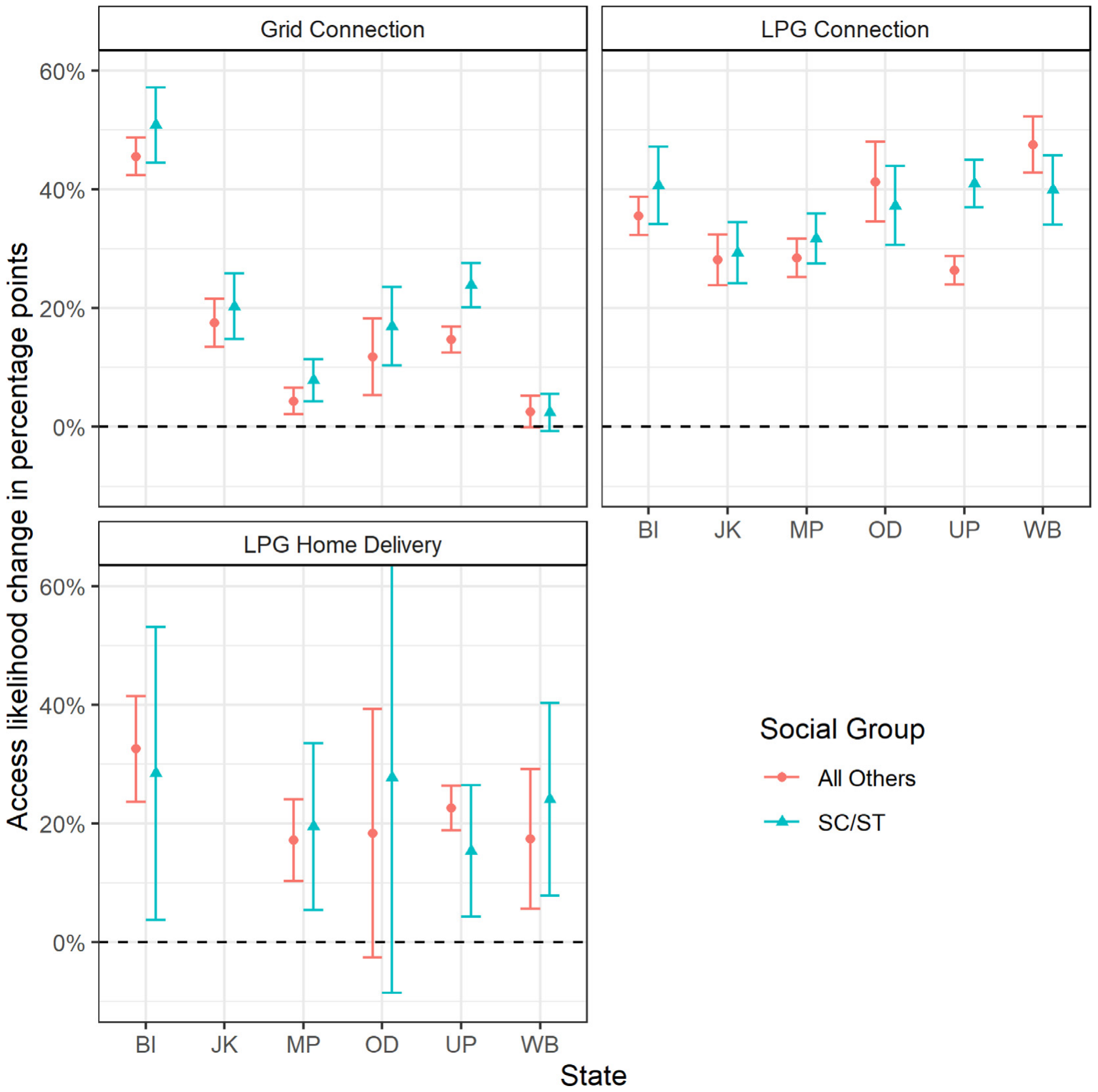
Disaggregate analysis suggests these broad trends are composed of distinct state-level patterns shaped by baselines, marginalized population distributions, institutional capacity and accountability. In Bihar and Uttar Pradesh, the two states with the most noticeable improvements in connection rates, supply quality improved faster for the general than the Scheduled Caste population, while in the states with large Scheduled Tribe populations all households improved but the previously disadvantaged did not catch up.
In summary, household energy access policies that do not ensure adequate supply provision for all sections of the population risk perpetuating historical caste-based inequities in rural northern India. Without a multi-dimensional understanding of energy supply that looks beyond connections, improvements to supply infrastructure will continue to lag behind the connection of remote and hard to reach communities, restricting their capabilities to access necessary energy services. These outcomes continue to remain obscured in binary connection-based government reported statistics, and we argue that energy policy reform must account for caste-based inequities and use multi-dimensional supply measurement to encourage equitable and just progress towards sustainable energy access for all.
@article{pelz_energy_2021,
	title = {Energy access for marginalized communities: {Evidence} from rural {North} {India}, 2015–2018},
	volume = {137},
	copyright = {All rights reserved},
	issn = {0305750X},
	shorttitle = {Energy access for marginalized communities},
	url = {https://linkinghub.elsevier.com/retrieve/pii/S0305750X20303314},
	doi = {10.1016/j.worlddev.2020.105204},
	abstract = {Rural energy access in India has improved steadily over the last decade. This progress is attributed to national energy reforms that aim to not only expand access to grid electricity and liquefied petroleum gas (LPG) but also to improve quality of access. Considering the historical caste-based energy access disparities unique to the Indian context, how equitable have recent improvements been? Using panel data representative of rural areas in six of India’s poorest states, we apply a linear regression model with caste and year interactions to quantify changes in energy access for historically marginalized Scheduled Caste and Scheduled Tribe (SC/ST) households relative to the all others between 2015–2018. We find that overall, inequities in an SC/ST household’s likelihood to obtain an LPG connection reduced (by 4.6\%-points [95\% CI: 0.7 to 7.7]). In contrast, overall inequities in grid connection likelihoods remained consistent. Looking beyond binary connection rates, we find that an SC/ST household’s supply improved less in terms of daily supply hours (by 1.42 h [CI: 1 to 1.83]) and monthly outage days (by 1 day [CI: 0.7 to 1.3]). Disaggregate analyses indicate that these broader trends are composed of distinct state-level trends modified by differences in baselines, marginalised population distributions, institutional capacity and accountability. Energy policy reform in India must consider caste-based inequities and take advantage of multi-dimensional supply measurement to encourage equitable and just progress towards sustainable energy access for all sections of the population.},
	language = {en},
	urldate = {2023-01-28},
	journal = {World Development},
	author = {Pelz, Setu and Chindarkar, Namrata and Urpelainen, Johannes},
	month = jan,
	year = {2021},
	pages = {105204},
}