Fairness considerations in global mitigation investments
Least-cost abatement locations do not determine fair contributions to mitigation finance
Where to abate is not who should contribute
Mitigation finance is routinely discussed as a single problem with a single answer, in which the cost-effective location of abatement is taken to indicate where investment should originate. Those are two different questions, and merging them has a predictable direction of error: it assigns the financing burden to the regions where abatement is cheapest, which are disproportionately regions with the least capacity to fund it and the smallest historical contribution to the problem.
We ask how regional contributions to global cost-effective mitigation investment needs change when equity considerations are applied, and what direction and magnitude of interregional financial flows each consideration implies. The separation is the central contribution. Keeping the geography of least-cost abatement distinct from the distribution of contributions is what makes the fairness judgement visible. Adequate capital and liquidity are globally available, so the binding constraint on mitigation finance is distributional rather than absolute.
Six equity indicators, ten regions, no weighting
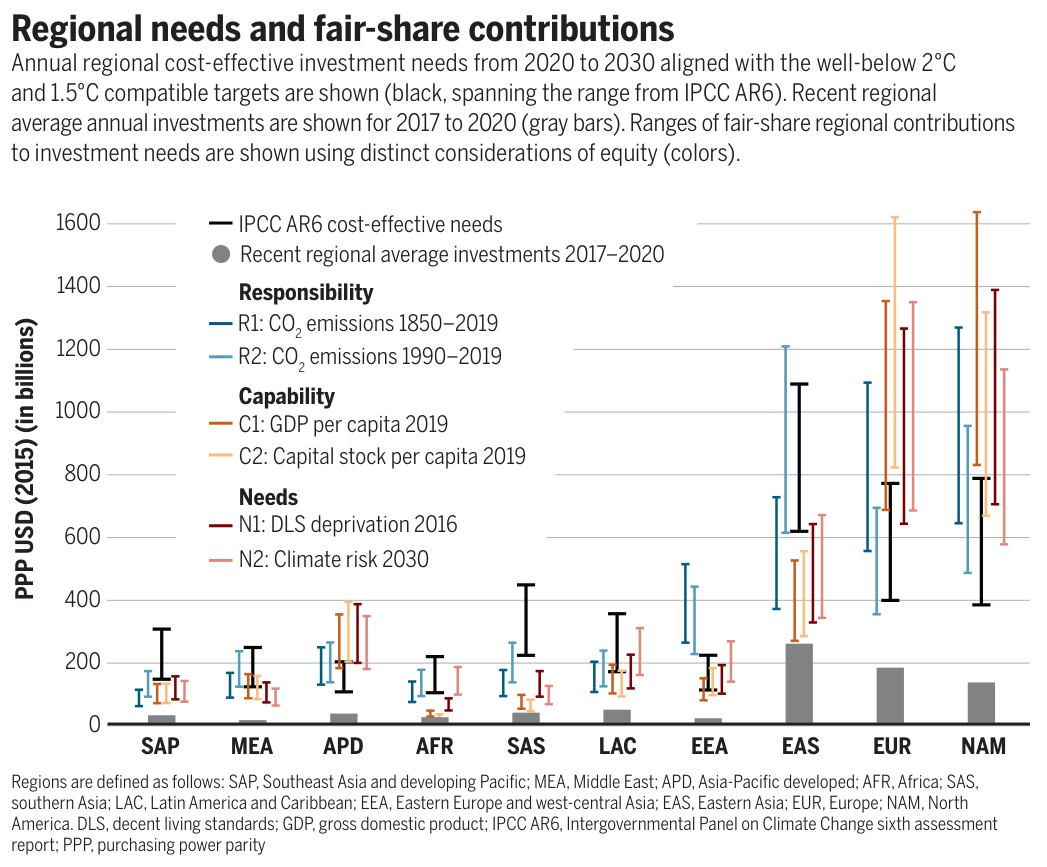
We take modelled regional cost-effective annual mitigation investment needs for the decade 2020 to 2030 from the IPCC AR6 WGIII Technical Summary, and derive 'fair share' regional contributions for all ten IPCC regions under six indicators grouped in three considerations. Responsibility is represented by cumulative CO2 emissions from fossil fuels and industry since 1850 and since 1990. Capability is represented by GDP per capita and capital stock per capita in 2019. Needs are represented by decent living standards deprivation and by climate risk in 2030.
Responsibility indicators translate cumulative historical emission shares directly into shares of total mitigation investment contributions. Capability and needs indicators are scaled by regional GDP and normalised, so that each region contributes a share of its GDP in proportion to its indicator value relative to others, with the needs indicators first inverted because they measure deprivation. We do not attempt to combine the equity considerations or weight the indicators, instead presenting the allocations corresponding to each distinct consideration and providing an accompanying tool that allows users to select and weight indicators themselves.
Fair shares diverge from least-cost geography
Current mitigation finance is both inadequate and unfair. Total global annual cost-effective mitigation investment needs range from approximately 2.31 to 4.57 USD trillion per year over the decade, against roughly 0.72 USD trillion per year of mitigation investment across 2017 to 2020, and the IPCC assesses that flows must increase globally by a factor between three and six to meet average annual needs until 2030.
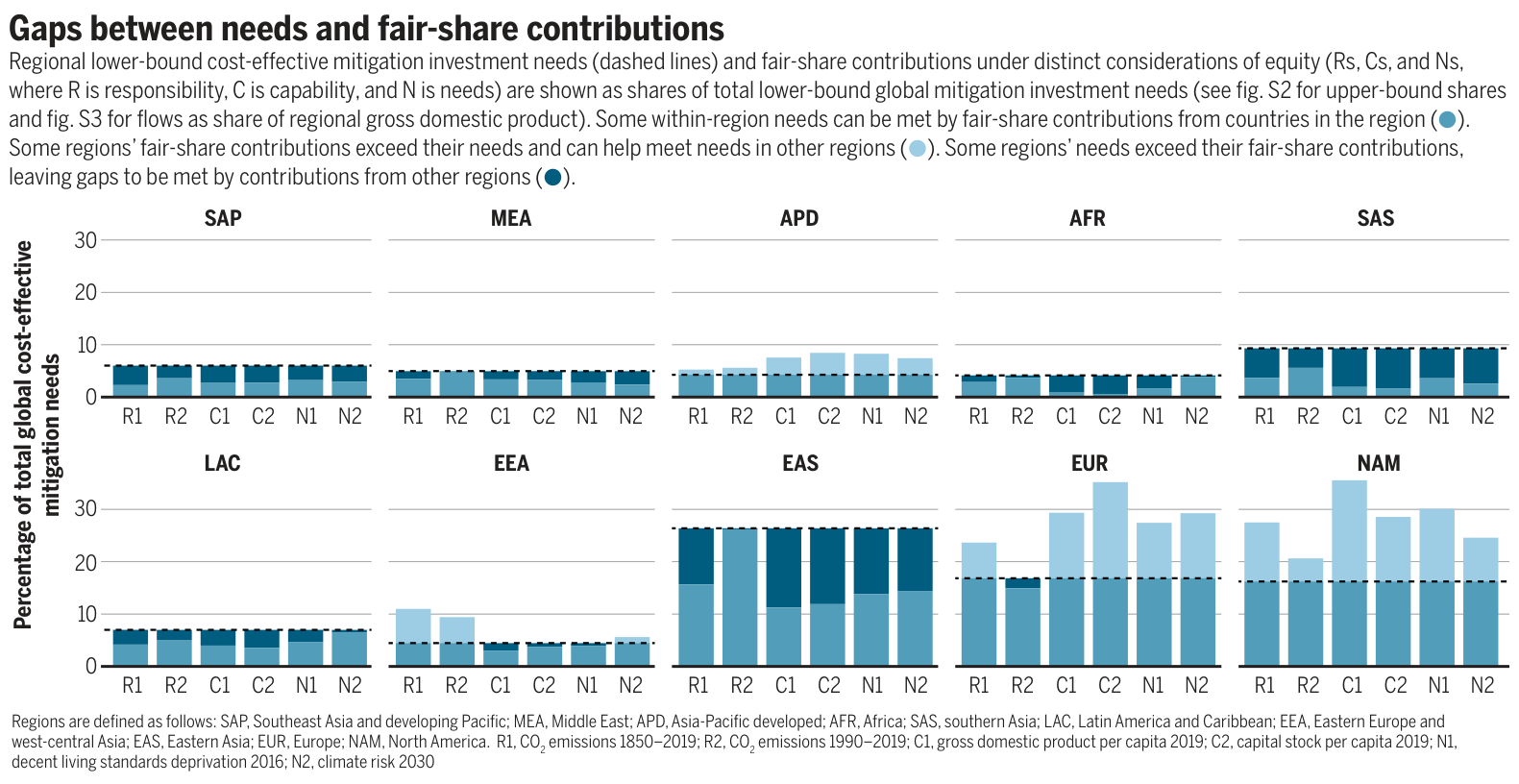
We find that with the exception of responsibility measured from 1990, fair-share contributions under any equity consideration would be far higher than cost-effective needs in North America and Europe, and lower in Africa, South and Southeast Asia, and Latin America. Our estimated range of interregional flows required to meet fair-share contributions is between 248 and 1,581 USD billion annually during 2020 to 2030. Capability- and needs-based allocations require substantial flows of 657 USD billion to 1.581 USD trillion to regions dominated by low- and middle-income countries. Even under responsibility since 1990, the indicator most favourable to regions of the Global North, annual interregional flows for mitigation alone must increase to between 250 and 570 USD billion in the near term.
Least-cost location is not fair allocation
Our results indicate that interregional flows must be scaled up no matter which combination of equity considerations and indicators we consider. This robustness is central to the argument: the requirement for transfers is not an artefact of choosing a particular notion of fairness, and no choice of indicator removes the requirement.
We argue that continued neglect of differentiated responsibilities, capabilities, and needs in the regional allocation of mitigation investment contributions risks lose-lose outcomes, and that interregional cooperation is necessary to move past this gridlock. Treating the least-cost location of abatement as though it were a fair allocation of contributions entrenches existing advantage while presenting the result as a neutral technical finding. Our work describes one pathway toward finding consensus, by embedding distinct considerations of distributional justice in the derivation of 'fair' regional contributions to globally cost-effective mitigation investment needs. On every indicator we examine, distributive justice in global climate mitigation will require substantial interregional finance flows.
@article{pachauri_fairness_2022,
	title = {Fairness considerations in global mitigation investments},
	copyright = {All rights reserved},
	issn = {0036-8075, 1095-9203},
	url = {https://www.science.org/doi/10.1126/science.adf0067},
	doi = {10.1126/science.adf0067},
	abstract = {Current mitigation finance flows are inadequate and unfair},
	language = {en},
	urldate = {2022-11-18},
	journal = {Science},
	author = {Pachauri, Shonali and Pelz, Setu and Bertram, Christoph and Kreibiehl, Silvie and Rao, Narasimha D. and Sokona, Youba and Riahi, Keywan},
	month = nov,
	year = {2022},
	pages = {eadf0067},
}