Disaggregated household energy supply measurement to support equitable municipal energy planning in rural Nepal
Disaggregated household measurement exposes energy supply inequities that national aggregates hide
The data available to municipal energy planners
Nepal's federal restructuring devolved responsibility for local energy planning to rural municipalities, which are now expected to produce and act on energy improvement plans. The data available to them is national or district-level, and describes an average household that may exist nowhere within their boundaries.
In rural Nepal, nationally representative survey data reveals that just 67% of households are connected to the national grid, while 27% rely on off-grid technologies such as minigrids and standalone solar systems, and 72% remain reliant on biomass for cooking and heating. Aggregates of this kind establish the scale of a supply deficit without locating it. They cannot tell a municipal leader which settlements are unserved, which households within a served settlement are not connected, or whether the burden of poor supply falls disproportionately on poorer constituents. We ask how survey sampling, multi-tier supply measurement and spatial disaggregation can be combined to produce baselines at the scale at which planning decisions are now made.
Gridded sampling, then spatial and wealth disaggregation
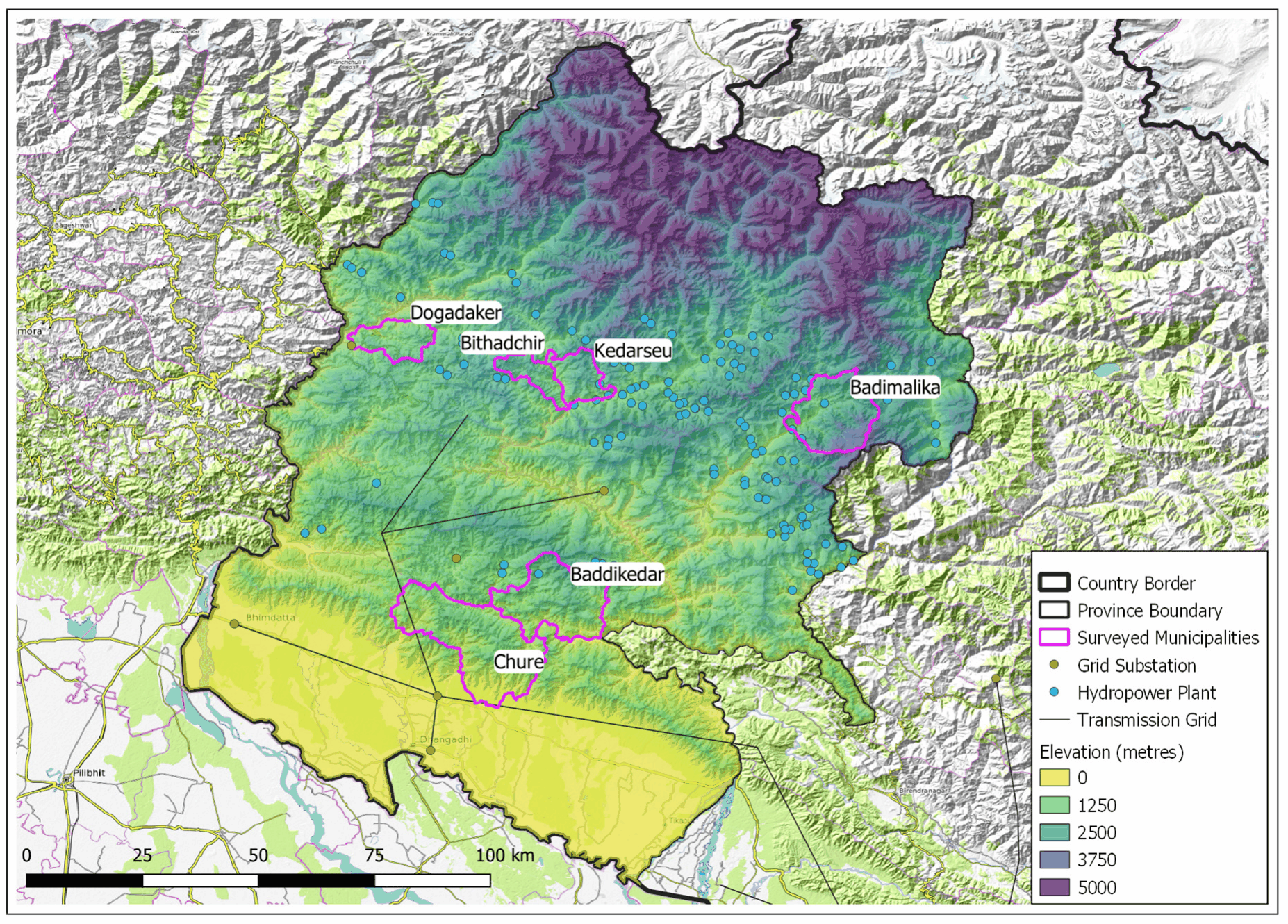
We surveyed 2,357 households across six rural municipalities in the hilly region of Sudurpashchim Pradesh in far-western Nepal during June and July 2018. Households were selected by probability proportionate to estimated size over remotely sensed gridded population data, using the GridSample approach with clusters of ten households and a minimum population threshold per pixel, and enumerated on tablets using Kobo Toolbox.
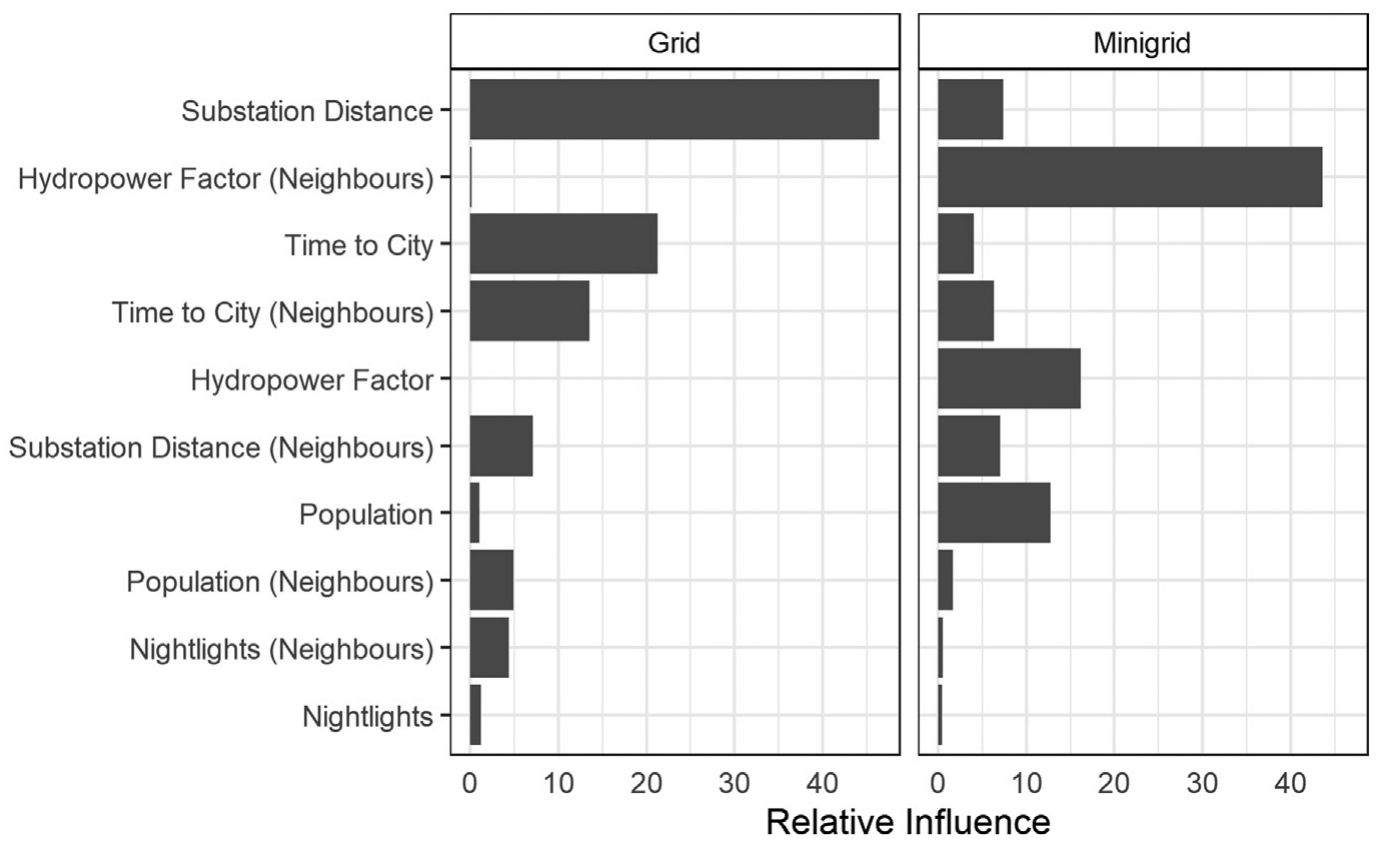
Supply is characterised along attributes adapted from the Multi-Tier Framework but deliberately analysed continuously rather than cut into tiers: nominal supply capacity derived from fuse amperage or peak photovoltaic capacity, and supply duration, which we aggregate into a supply-access index equal to the mean supply duration of electrified households multiplied by the electricity access rate and divided by 24 hours. Energy service utilisation is collapsed into three ordinal levels, and cooking is grouped into unimproved stoves, improved stoves and liquefied petroleum gas. Disaggregation runs along two axes: wealth terciles constructed within each municipality, and geography, where survey data is binned to a hierarchical spatial index and boosted regression trees predict grid and minigrid connection likelihood per hexagon from travel time, night-time lights, population count, substation distance and a hydropower factor.
Severe geographic and wealth-related supply inequality
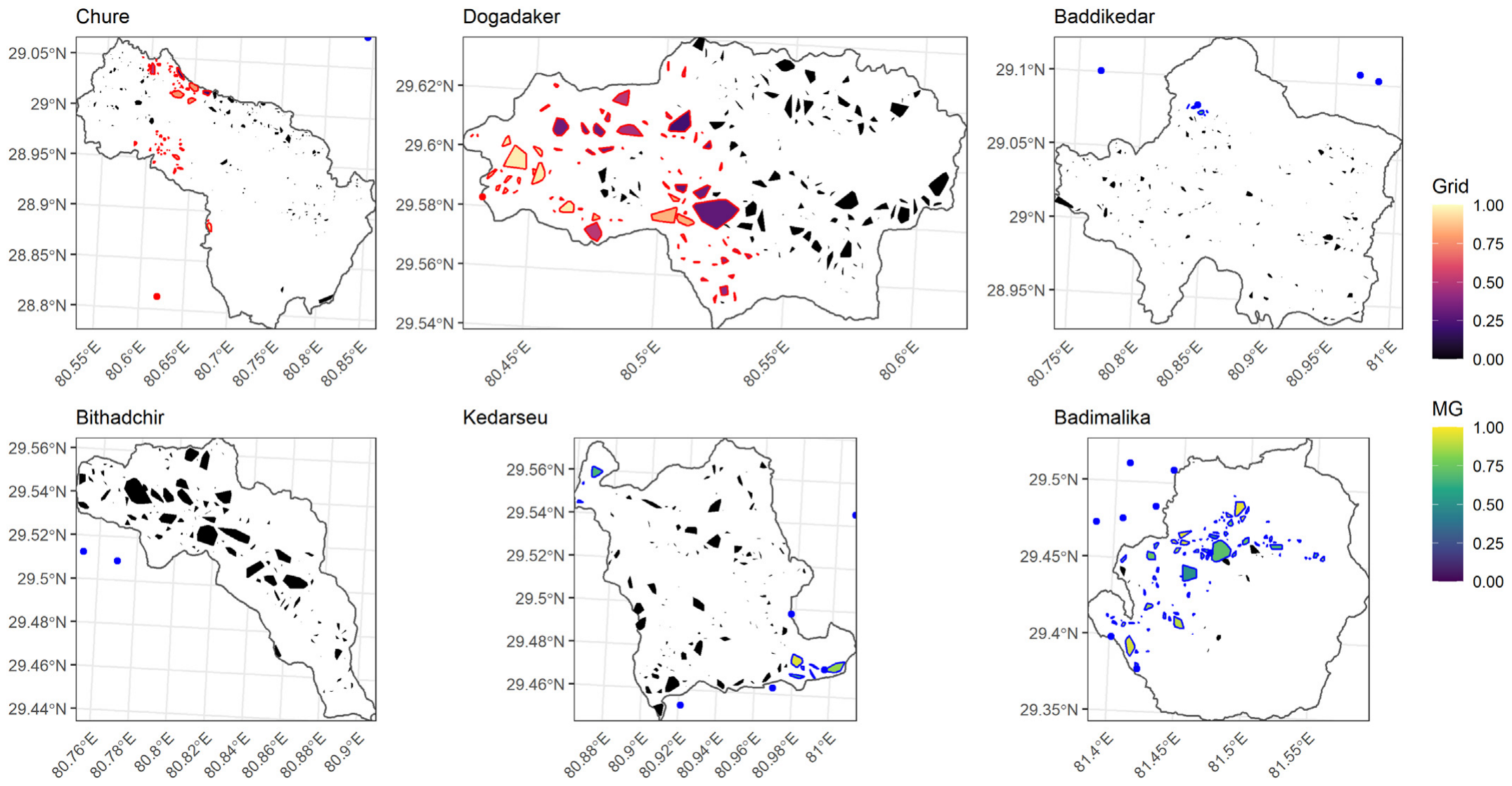
Application and analysis of the household surveys across the six rural municipalities reveals severe geographic and wealth-related inequalities in energy supply provision and associated burden. Grid connection rates among surveyed households were 17% in Chure and 31% in Dogadaker, and zero in the remaining four municipalities. Minigrid provision follows an almost inverse and equally uneven pattern, reaching 59% of surveyed households in Badimalika against 3% in Baddikedar and Bithadchir, 10% in Kedarseu, and none at all in Chure or Dogadaker.
Cost does not appear to explain the pattern. Households in all wealth groups, including the lowest, typically spend less than 5% of their annual expenditures on electricity, and median annual electricity expenditures remain constant or increase by under a third between the bottom and top expenditure groups across all municipalities. Cooking varies little across expenditure groups: stove stacking is uncommon, with under 10% of households across all municipalities using more than one stove, and utilisation of improved and liquefied petroleum gas stoves is so low that distinctions across expenditure groups are not readily identifiable, except in Badimalika.
Disaggregation as the basis for equitable planning
The spatial models were validated against held-out hexagons, returning an area under the curve of 0.841 for grid and 0.817 for minigrid prediction, and the resulting population clusters capture between 91% and 97% of each municipality's mapped population. That coverage makes the results usable as a municipal planning baseline.
The data generated provides municipal leaders with accurate information regarding supply challenges faced by all of their constituents. This represents a transparent starting point for the development of municipal energy access improvement plans, enables assessment of improvement over time, and can support calibration of top-down plans in discussion with the federal government. It is particularly useful for understanding where connection intensification, through the national grid or through standalone solar systems, is necessary, and it brings to light the plight of poorer households that sit under the grid without being connected to it. We argue that disaggregated measurement is crucial for transparent and equitable energy supply improvement planning.
@article{pelz_disaggregated_2020,
	title = {Disaggregated household energy supply measurement to support equitable municipal energy planning in rural {Nepal}},
	volume = {59},
	copyright = {All rights reserved},
	issn = {09730826},
	url = {https://linkinghub.elsevier.com/retrieve/pii/S097308262030291X},
	doi = {10.1016/j.esd.2020.08.010},
	abstract = {Equitable energy supply planning is nearly impossible in regions with limited data availability. Lack of representation among marginalised populations can perpetuate existing structural and socio-cultural inequities, despite aggregate improvements to energy supply. In Nepal, this represents an acute challenge for the 460 rural municipalities recently tasked with improving supply provision for their constituents. Since the last census in 2011, the country has undergone significant political changes as well as suffering several natural catastrophes. In this context, data collection and analysis methods are needed to support local decision makers in developing equitable energy supply improvement plans. This work highlights the role of disaggregated household energy supply measurement to capture contextual inequities that are typically lost in national or state level aggregates. Methods for efficiently collecting and analysing spatially representative household energy access survey data are described. Application and analysis of household surveys (N = 2357) across six rural municipalities in Sudurpashchim Pradesh, far western Nepal, reveals severe geographic and wealth-related inequalities in energy supply provision and associated burden. The results enable municipal planners to not only understand the magnitude, but also the spatial dimension of the supply deficit. Disaggregated measurement is crucial for transparent and equitable energy supply improvement planning.},
	language = {en},
	urldate = {2023-01-28},
	journal = {Energy for Sustainable Development},
	author = {Pelz, Setu},
	month = dec,
	year = {2020},
	pages = {8--21},
}