Electricity supply quality and use among rural and peri-urban households and small firms in Nigeria
An open survey of 3,599 households and 1,122 firms on Nigerian electricity supply quality
An open dataset on supply, not connections
According to the World Bank, the electricity access rate in Nigeria stood at 55.4% in 2020, with a large gap between urban and rural areas at 83.9% against 24.6%. Behind those connection figures sits a supply problem that connection statistics do not record: the average grid-connected household receives just 6.6 hours of supply on a typical day, linked to a per capita consumption of just 144 kWh per year, against 351 kWh in Ghana and 4,198 kWh in South Africa.
The consequences are visible in the enterprise sector, where 27% of Nigerian firms identified reliability of electricity supply as the main obstacle to their business, with an average of 32.8 power outages in a typical month leading to an estimated 11% loss in sales value. Many Nigerians have resorted to self-generation using petrol and diesel generators, spending approximately 1.56 trillion Naira, or 3.76 billion USD at 2021 average exchange rates, per year on fuel. What has been missing is disaggregate data on what supply actually looks like, and what households and firms do with it, in the grid-electrified communities outside the urban core.
A remotely sensed frame, 225 enumeration areas
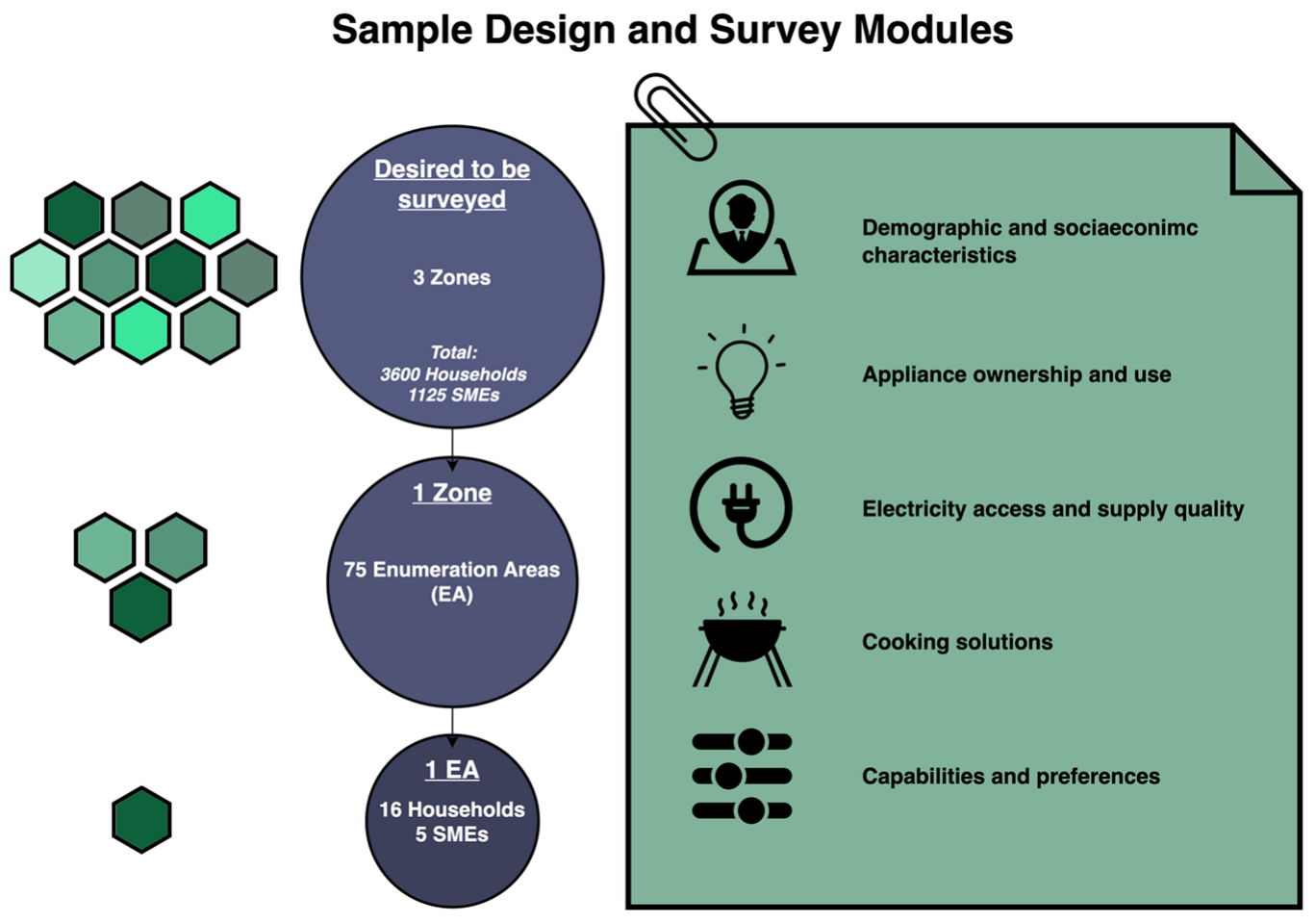
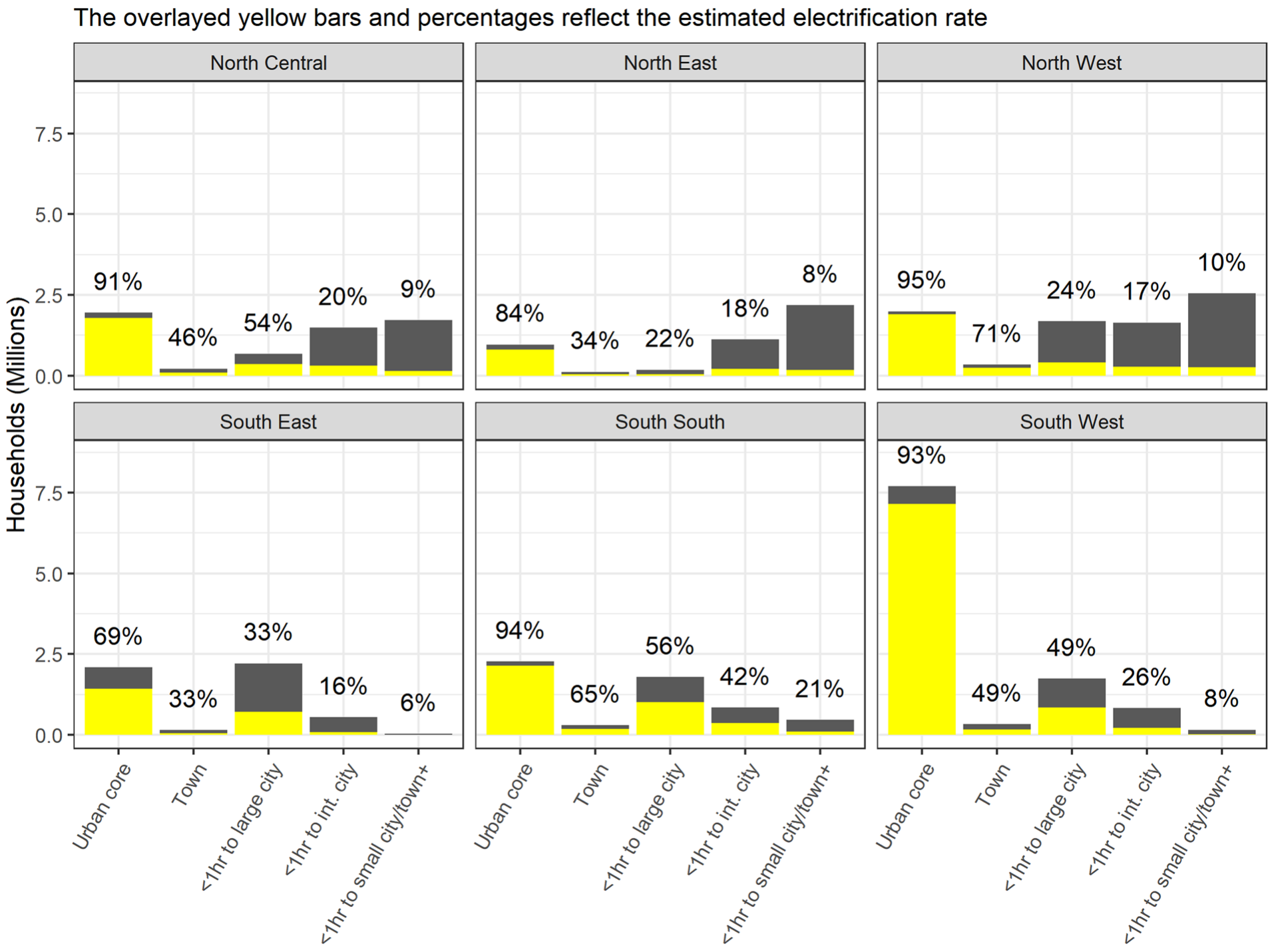
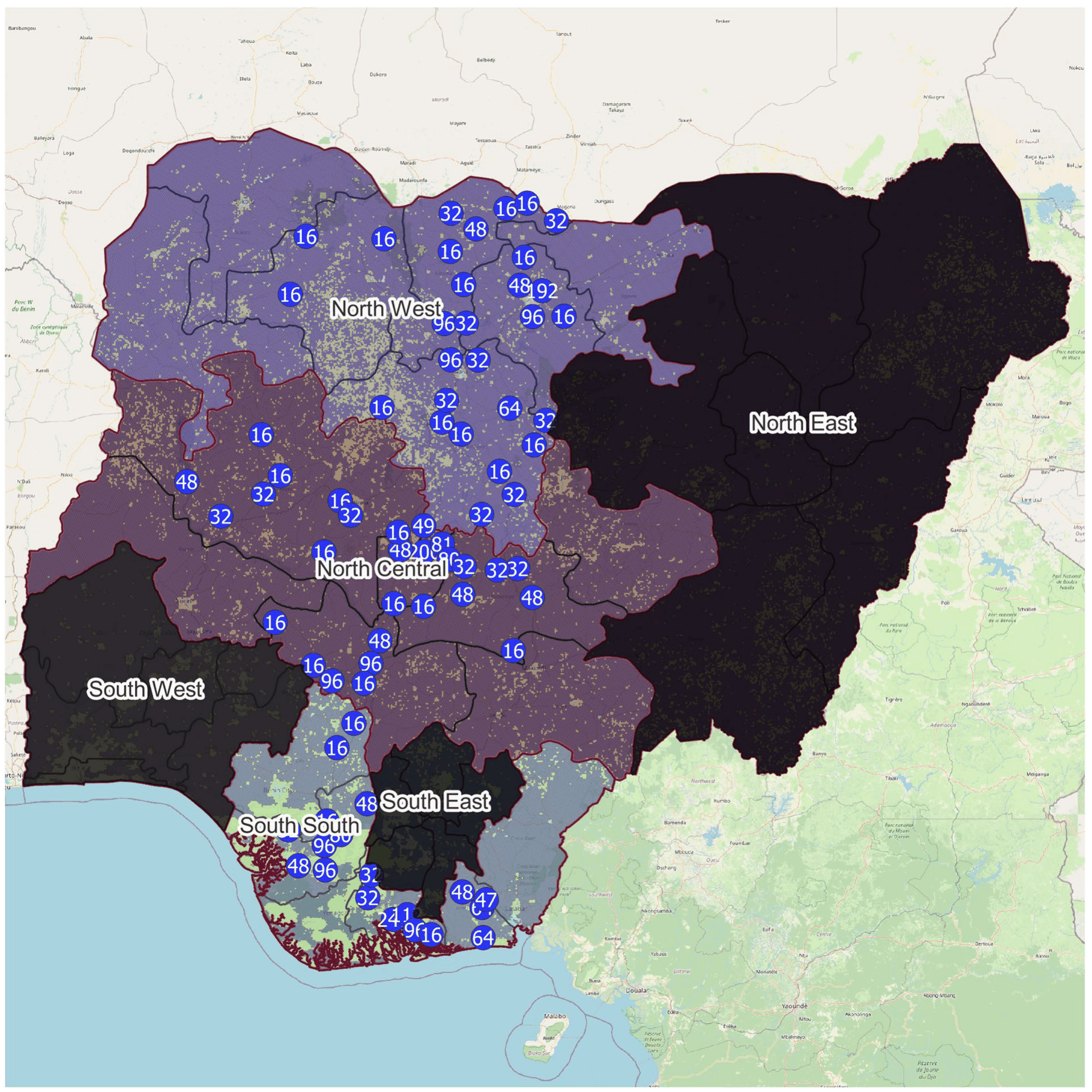
Given the lack of up-to-date administrative data, we build the sampling frame from remotely sensed sources: a WorldPop bottom-up population estimate, the Urban Rural Catchment Area layer describing travel time to the nearest agglomeration, and AtlasAI electrification and asset-index rasters. Three geopolitical zones were selected purposefully, North West, North Central and South South, on the basis of lower rates of urbanisation and of safety and associated logistical concerns.
Within each zone we applied two-stage probability-proportionate-to-size sampling, first across states weighted by household counts, then across enumeration areas, with proportional stratification across rurality categories to correct for any bias introduced by pre-sampling states. Data collection commenced on 7 August 2021, implemented by eHealth Africa using Kobo Collect computer-assisted personal interviews, with 60 enumerators and 12 state supervisors working in teams of two that were mostly paired male and female, covering 16 households and 5 enterprises per enumeration area. Questionnaire modules draw on established energy surveys, most directly from the Multi-Tier Framework for Measuring Energy Access.
What the instrument records
The final sample includes 3,599 households and 1,122 small and medium-sized enterprises from 225 enumeration areas across the three geopolitical zones. Rather than recording only whether a household or firm is connected, the instrument captures the conditions of supply and use behind that connection: demographic and socioeconomic characteristics, energy access and supply quality, appliance ownership and usage time, cooking solutions, energy-related capabilities, supply preferences, and trust in institutions, alongside several gender-disaggregated variables.
The released files include household and enterprise codebooks and choice lists, anonymised datasets, stove and appliance rosters for both households and enterprises, an enterprise equipment roster, and a per-enumeration-area geospatial key, with sample point coordinates jittered up to 10 km in published figures. Technical validation during cleaning found that one enumeration area in North Central and six in North West were not grid-connected but used other forms of electricity such as diesel generators or solar devices, and one area contained 15 rather than 16 households owing to banditry on the final day of enumeration.
Modelling demand for communities not yet reached
This is a data descriptor, and it reports no survey-derived results of its own. Its value lies in what the data supports, and we suggest three avenues of further research.
First, modelling appliance ownership likelihoods, electricity consumption levels and energy service needs in un-electrified regions, since surveyed appliance use among grid-connected communities can serve as a proxy for future demand among similar households that are not yet connected. Second, identifying supply-side and demand-side solutions to address the high usage of diesel generators, for which the data provides evidence on grid supply reliability, backup prevalence and energy service needs. Third, exploring broader issues of multi-dimensional energy access, access to decent living standards and climate vulnerability, since the data captures objective appliance ownership and use alongside subjective satisfaction with basic energy services such as keeping oneself at a comfortable temperature. A common theme across all three is the importance of improving central grid supply quality and providing cost-competitive decentralised alternatives.
@article{pelz_electricity_2023,
	title = {Electricity supply quality and use among rural and peri-urban households and small firms in {Nigeria}},
	volume = {10},
	copyright = {All rights reserved},
	issn = {2052-4463},
	url = {https://doi.org/10.1038/s41597-023-02185-0},
	doi = {10.1038/s41597-023-02185-0},
	abstract = {We present a household and enterprise energy survey dataset collected within the framework of the PeopleSuN project in Nigeria in 2021. Across three Nigerian geopolitical zones, a total of 3,599 households and 1,122 small and medium-sized enterprises were surveyed. The sample is designed to be representative of rural and peri-urban grid-electrified regions of each zone. Our surveys collect data on demographic and socioeconomic characteristics, energy access and supply quality, electrical appliance ownership and usage time, cooking solutions, energy related capabilities, and supply preferences. We encourage academic use of the data presented and suggest three avenues of further research: (1) modelling appliance ownership likelihoods, electricity consumption levels and energy service needs in un-electrified regions; (2) identifying supply-side and demand-side solutions to address high usage of diesel generators; (3) exploring broader issues of multi-dimensional energy access, access to decent living standards and climate vulnerability.},
	number = {1},
	journal = {Scientific Data},
	author = {Pelz, Setu and Chinichian, Narges and Neyrand, Clara and Blechinger, Philipp},
	month = may,
	year = {2023},
	pages = {273},
}