Advancing representations of equity and justice in climate mitigation futures
A typology of how global mitigation scenarios fall short on equity, and a research agenda to fix it
What scenarios cannot say about justice
Global modelled scenarios from integrated assessment models are a mainstay of international climate policy analysis, and they increasingly carry weight in deliberations about how mitigation effort should be distributed. The equity content of those scenarios receives far less scrutiny than their technical content.
Some limitations are matters of resolution that further model development can address. Others are structural, arising from who builds the scenarios and whose perspectives are represented in them, and others still are epistemological, concerning what this class of tool can meaningfully articulate about justice at scales relevant to policy deliberation. Conflating the three leads to a predictable failure, in which a limitation requiring a change in practice is treated as one awaiting a technical fix. We conduct a narrative review of pressing equity and justice issues within global modelled scenarios and propose a research agenda to strengthen their consideration in future model developments and applications. Keeping the three apart allows the agenda to prescribe the appropriate remedy for each.
A typology organised by functional area
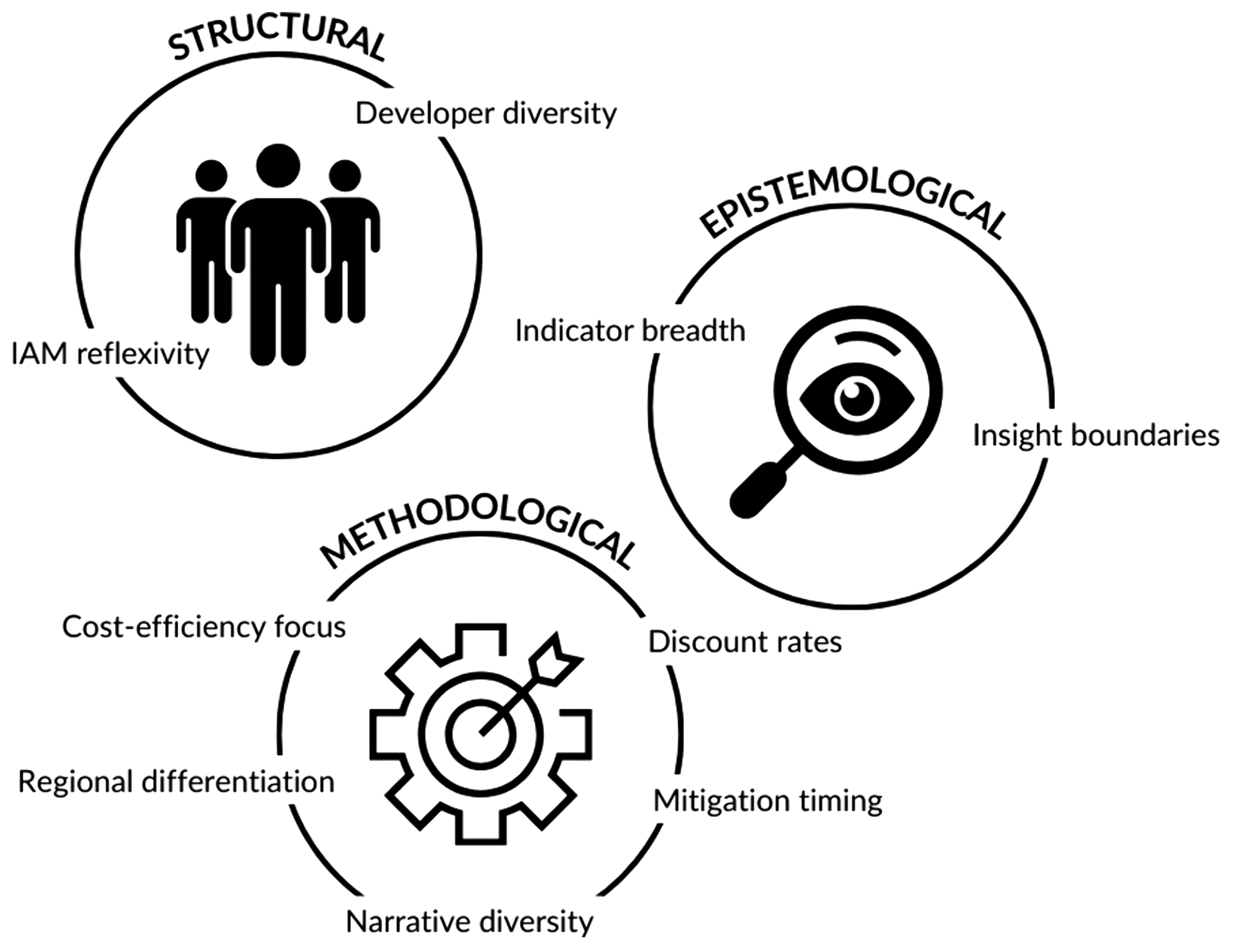
We organise the literature into functional areas of action, distinguishing that which relates to those engaged in developing scenarios and modelling tools, which we term structural, the nature of the scenarios and tools themselves, which we term methodological, and what they can inform, which we term epistemological. Structural aspects influence who generates scenario knowledge and whose perspectives are emphasised; methodological aspects concern technical modelling choices that reflect underlying normative orientations; epistemological aspects define the scope of what these models can articulate about justice.
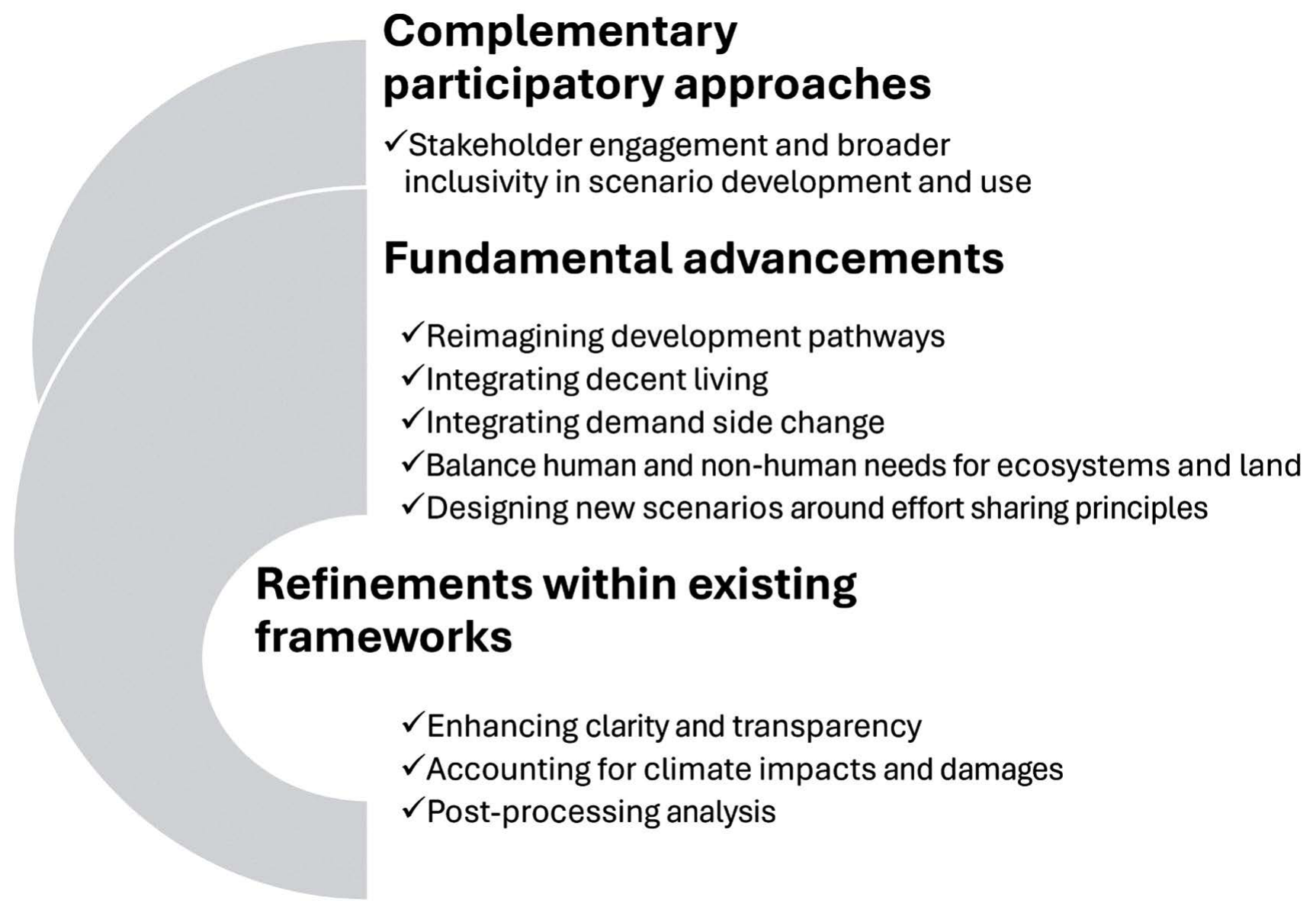
We identify key contributions through expert assessment by the authors, who have several decades of combined experience working on climate policy modelling and justice scholarship, supplemented through snowball sampling of highly cited works and recent publications addressing critiques from a justice perspective. We aim to synthesise a diverse set of critiques into a coherent typology that informs the way forward, rather than providing a systematic review of the broader literature. The typology is then mapped into a research agenda distinguishing incremental refinements within existing frameworks, fundamental reforms of scenario and model design, and complementary participatory approaches.
Three dimensions where equity drops out
Structurally, the concerns are the diversity of scenario developers and the reflexivity and positionality of integrated assessment modelling communities. Methodologically, they run through the diversity of scenario narratives and assumptions, the focus on cost-efficiency, the treatment of discount rates, regional differentiation, and mitigation timing with its associated reliance on carbon dioxide removal. Epistemologically, they concern the breadth of indicators reported and the boundaries of the insights these tools can support.
One quantitative illustration is instructive. The middle-of-the-road pathway assumes limited convergence in energy consumption and emissions, yet its projected reductions in income inequality are still about twice as fast as observed recent trends, which suggests that even this baseline may be optimistic regarding equity improvements. A related risk runs through the methodological critiques: models minimising global costs under decent living standards constraints may still allocate most mitigation effort to poorer regions just above sufficiency thresholds, allowing high consumption to persist elsewhere. Alternative normative principles, including sufficientarianism, prioritarianism and limitarianism, offer more nuanced guidance for evaluating emissions responsibilities and resource entitlements than egalitarian defaults alone.
Opening up equitable pathways
Three priority actions stand out as particularly urgent. Equity and effort-sharing principles must be integrated directly into scenario design rather than relying on post hoc allocation analysis, by embedding differentiated carbon budgets and climate finance flows within model structures from the outset. New scenario frameworks must explicitly incorporate sufficiency constraints, demand-side transformations, and alternative justice principles beyond egalitarianism, while protecting decent living standards and constraining excess consumption. And sustained, well-resourced engagement with researchers and stakeholders from underrepresented regions must move beyond consultation toward genuine co-production that shapes modelling priorities, assumptions and interpretations.
Underlying the agenda is a recognition that modelling communities must engage more critically with the implicit assumptions in scenario and model design and use that carry equity and justice implications. We argue that the value of climate mitigation scenarios will be determined not by their technical complexity but by their ability to open up possibilities for equitable pathways rather than restrict them. Justice cannot be fully captured through quantitative modelling; it must be pursued through ongoing deliberative negotiation, and decisions about how to share burdens and benefits remain fundamentally political.
@article{pachauri_advancing_2026,
	title = {Advancing representations of equity and justice in climate mitigation futures},
	volume = {5},
	copyright = {All rights reserved},
	url = {https://doi.org/10.1371/journal.pclm.0000763},
	doi = {10.1371/journal.pclm.0000763},
	number = {2},
	journal = {PLOS Climate},
	author = {Pachauri, Shonali and Brutschin, Elina and Gidden, Mathew J. and Hasegawa, Tomoko and Hejazi, Mohamad and Jiang, Kejun and Kikstra, Jarmo S. and Krey, Volker and Lamb, William F. and Mintz-Woo, Kian and Nauels, Alexander and Pelz, Setu and Rogelj, Joeri and Roy, Joyashree and Schaeffer, Roberto and Scheifinger, Karl and Sokona, Youba and Tavoni, Massimo and van Ruijven, Bas and Vinca, Adriano and Vishwanathan, Saritha Sudharmma and Zimm, Caroline and Riahi, Keywan},
	year = {2026},
	pages = {e0000763},
}