Electrification and productive use among micro- and small-enterprises in rural North India
Near-universal village electrification, yet 34% of rural enterprises stay unconnected
Does supply quality explain enterprise electricity use
India's rural grid expansion has been rapid and close to complete at the village level, and the development case for it rests substantially on the expectation that reliable supply will enable rural enterprises to connect, invest in appliances, and grow. Whether that mechanism operates is an empirical question that village-level electrification statistics cannot answer.
We ask three connected questions. Is grid supply quality related to rural micro and small enterprises' propensity to connect to the national grid? For those already connected, is supply quality related to their electricity consumption and to their likelihood of acquiring off-grid backup? And how do grid-connected and off-grid enterprises use the supply they have? The third question is the one most often skipped. Establishing what enterprises power determines whether electrification is plausibly a growth intervention at all in this setting, and whether the returns assumed by the policy case are available to be realised.
2,004 rural enterprises across 200 villages
We use the Rural Electricity Demand in India dataset, covering 2,004 rural micro and small enterprises drawn from 200 rural revenue villages across Bihar, Odisha, Uttar Pradesh and Rajasthan, with villages grouped into those served by a franchise-operated grid, a publicly operated grid, and a public grid alongside a minigrid. Grid supply hours are taken as the average of stated winter and summer supply duration as reported by revenue village leaders during the community survey, so the measure is not expected to be biased by enterprise characteristics.
We estimate a linear probability model with state and enterprise category fixed effects, and a linear regression on log monthly consumption, with standard errors grouped at the district level and numeric regressors centred and scaled by two standard deviations. Electricity consumption is an engineering estimate built from reported appliance usage hours and nominal wattages. We do not claim causal identification, and we note that any endogeneity between grid supply quality and broader development trends would be expected to bias estimates upwards, which makes null results the conservative reading.
Supply quality explains little of the variation
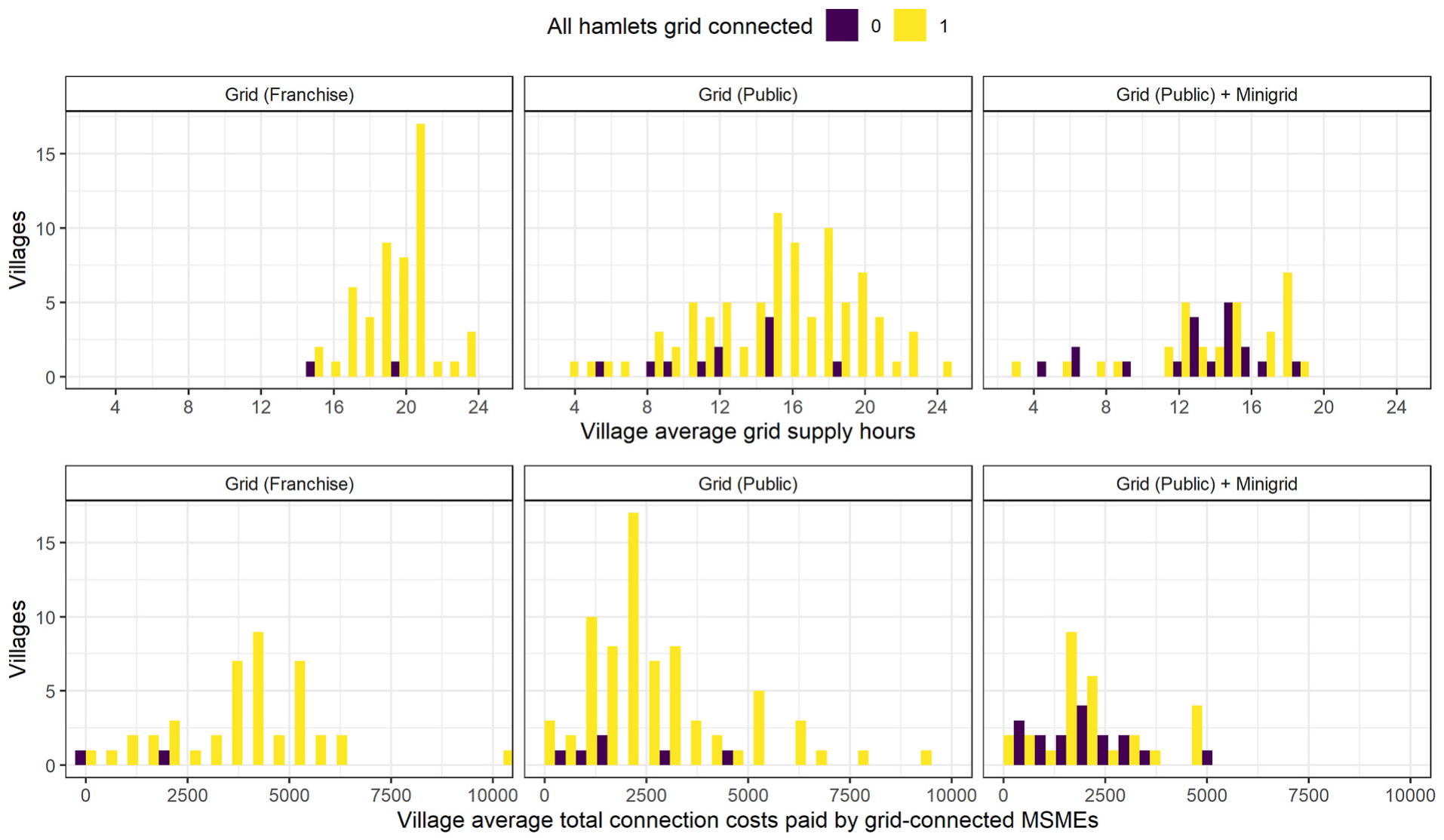
Puzzlingly, 34% of the 2,004 enterprises surveyed have no grid connection despite almost complete village grid electrification. Supply availability ranges broadly, from under 4 hours to 24 hours across the sample, with village-group averages between 14 and 19 hours, and fewer than 5% of sampled villages report supply above 20 hours per day. A further 22% of enterprises use both the grid and an off-grid backup, while 22% rely on off-grid sources alone.
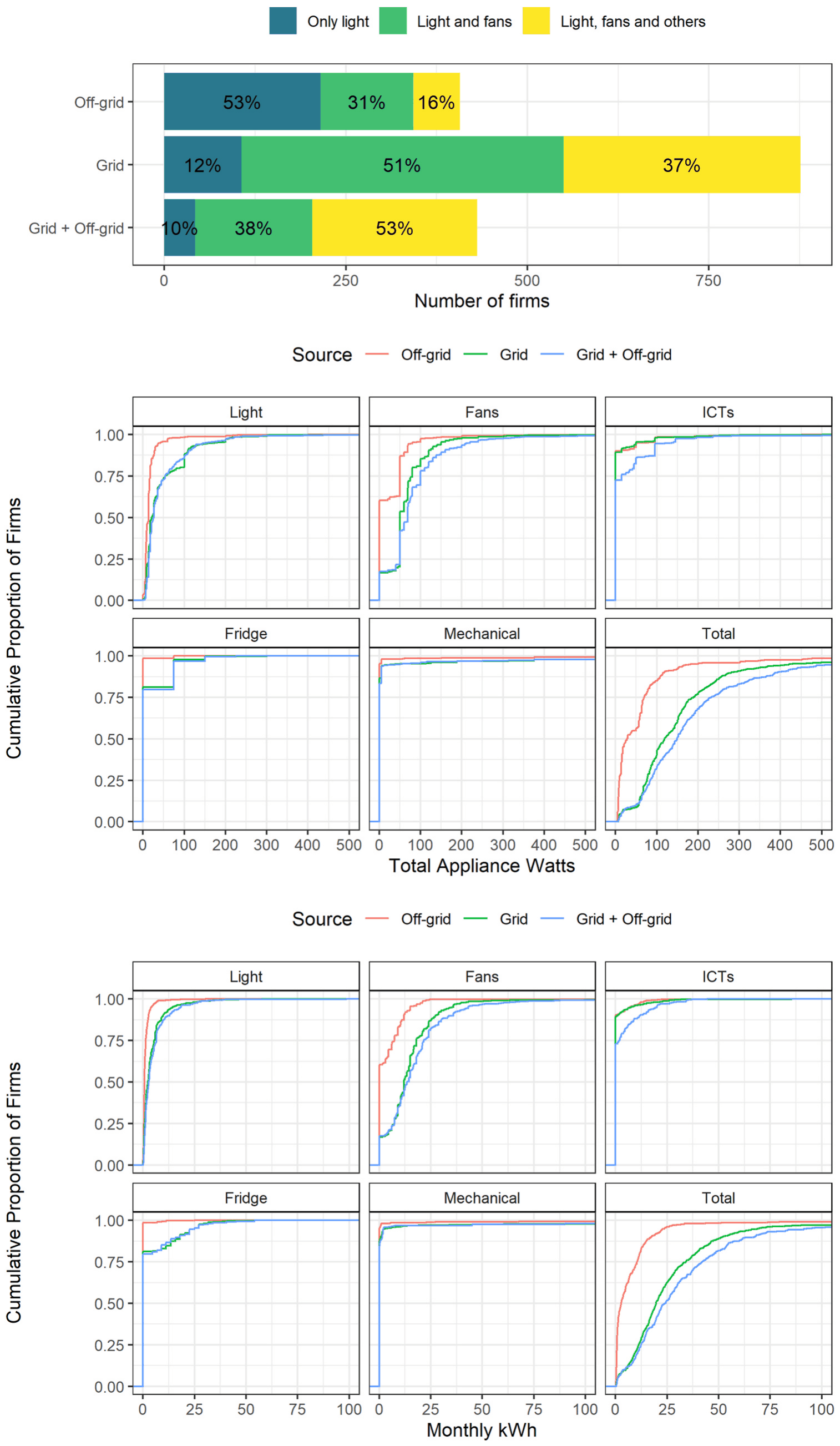
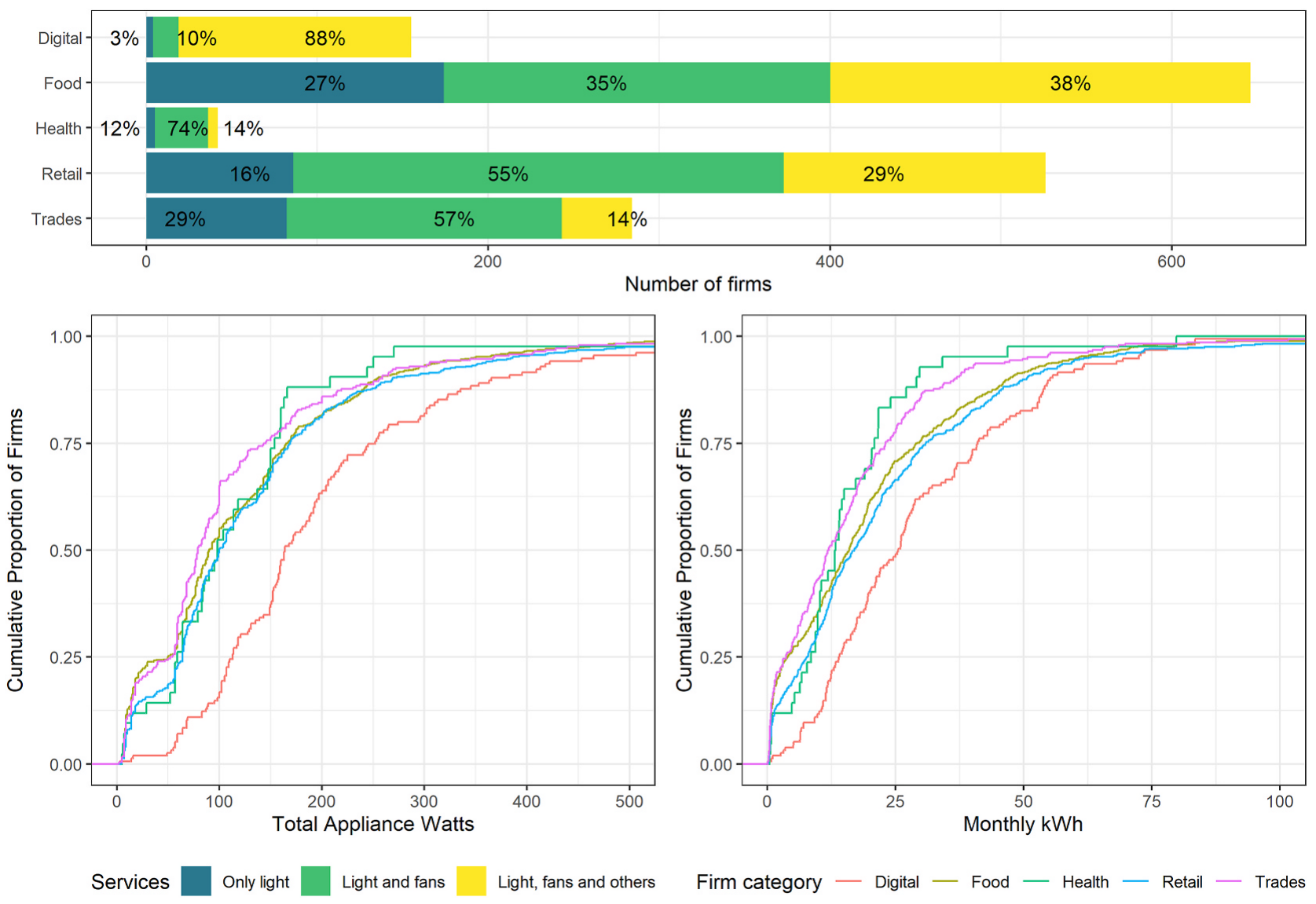
We find that village typical grid supply hours has a positive but statistically insignificant relationship with enterprise grid connection likelihood, no conclusive relationship with the propensity to secure off-grid backup, and no significant relationship with consumption. Wealth predicts all three: floor area, salaried employees and whether the building is pucca carry consistently significant coefficients. Utilisation is low throughout. Only 42% of grid-connected enterprises use appliances beyond lighting and fans, dropping to 18% among off-grid enterprises, and 75% of grid-connected firms own less than 200 watts of appliances, consuming just over 30 kWh per month.
Electrification alone will not deliver enterprise growth
These results are notable given the positive bias we expect from the likely endogeneity between grid supply quality and broader development trends. If anything, the estimates should overstate the relationship, and they still do not support it.
The policy implications are twofold. First, low consumption and correspondingly low revenues may weaken rural distribution companies' ability to maintain the expanded rural distribution network following recent electricity policy reforms. Second, the anticipated development impacts of expansive rural grid electrification policies may not materialise, at least with respect to rural enterprises in the states we assess and in the short term. We argue that India's progressive electrification policy driving rapid rural grid expansion may not have the desired growth impacts among rural enterprises in the absence of other complementary infrastructure and initiatives to ease wealth constraints. The binding constraint appears to sit with what enterprises can afford to buy and operate, not with the supply reaching them.
@article{pelz_electrification_2021,
title = {Electrification and productive use among micro- and small-enterprises in rural {North} {India}},
volume = {156},
copyright = {All rights reserved},
issn = {03014215},
url = {https://linkinghub.elsevier.com/retrieve/pii/S0301421521002718},
doi = {10.1016/j.enpol.2021.112401},
abstract = {The reported effects of electrification on rural entrepreneurship are mixed, with recent studies describing het erogeneity in outcomes and methodological challenges in attributing causal effects. Furthermore, the debate largely focuses on performance outcomes, rather than supply- and demand-side barriers to productive electricity use itself. In this paper, we contribute new evidence describing electricity use among micro- and smallenterprises (MSEs) in rural northern India. Puzzlingly, 34\% of the 2,004 MSEs surveyed have no gridconnection despite almost complete village grid electrification. We exploit variation in grid supply hours at village level, finding no conclusive link with this and MSE connection likelihoods. Rather, connection likelihood appears to be more closely related to wealth characteristics. Supporting this hypothesis, the reported electricity consumption appears equally unrelated to supply quality and quite low overall: 75\% of grid-connected MSEs consume less than 1 kW-hour per day, powering only lighting and fans. These results are notable given the positive bias we expect due to the likely endogeneity between grid supply quality and broader development trends, as noted in recent literature. Our work follows others in arguing that supply side improvements must occur in concert with demand side initiatives to unlock rural MSE electricity consumption. At the same time, the role of off-grid technologies in meeting nascent MSE electricity needs deserves further study.},
language = {en},
urldate = {2023-01-28},
journal = {Energy Policy},
author = {Pelz, Setu and Aklin, Michaël and Urpelainen, Johannes},
month = sep,
year = {2021},
pages = {112401},
}