Household energy service and home appliance choices in urban China
Climate shapes heating and cooling use; income drives advanced appliance ownership in urban China
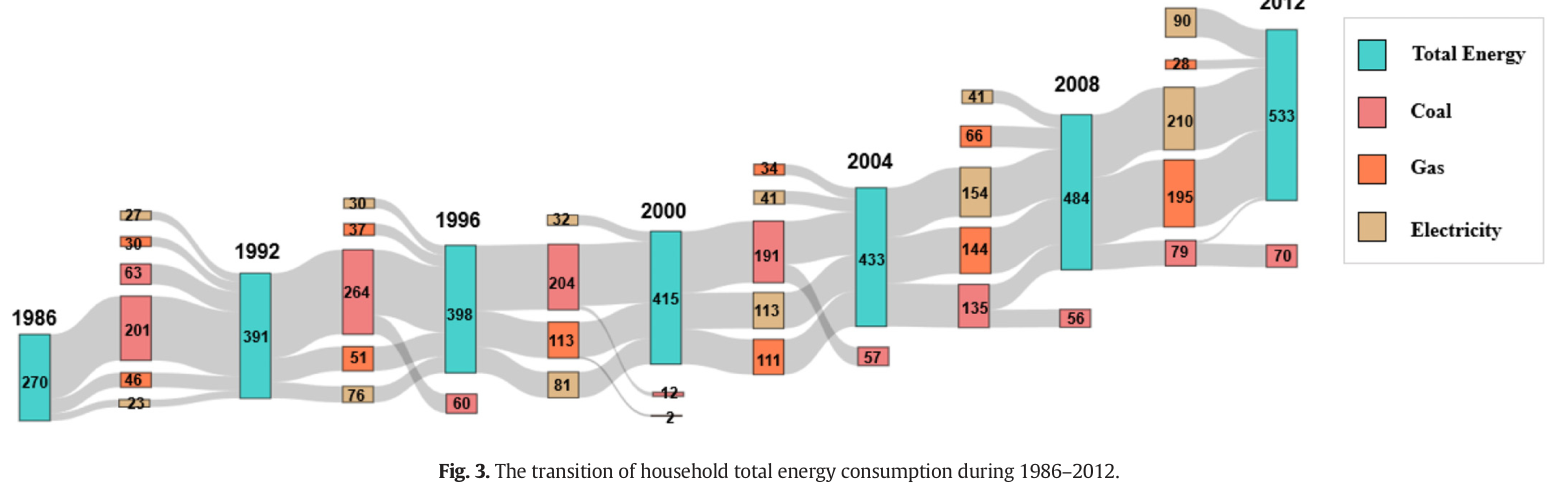
We examine factors associated with household energy service and home appliance choices from the perspective of 'energy-related well-being'. Using a nested choice model on microdata for China's urban households from 1986 to 2012, we regress combinations of energy service categories on socioeconomic, demographic, and climatic factors.
We find heating and cooling energy service use is associated more with climate than with other factors. Demographic factors are more related to access to basic appliances and information services, while acquisition of advanced appliances is more associated with household income.
Exploring the role of income, we find similar relationships with ownership of washing machines, TVs, and refrigerators, while income has a stronger relationship with ownership of microwaves, computers, and air conditioners. These results inform the factors driving home appliance selection and residential energy demand growth in China, where residential electricity consumption rose from 480 TWh in 1990 to 10,637 TWh in 2019.
@article{han_household_2022,
	title = {Household energy service and home appliance choices in urban {China}},
	volume = {71},
	copyright = {All rights reserved},
	issn = {09730826},
	url = {https://linkinghub.elsevier.com/retrieve/pii/S097308262200182X},
	doi = {10.1016/j.esd.2022.09.021},
	language = {en},
	urldate = {2023-03-01},
	journal = {Energy for Sustainable Development},
	author = {Han, Xiao and Poblete-Cazenave, Miguel and Pelz, Setu and Pachauri, Shonali},
	month = dec,
	year = {2022},
	pages = {263--278},
}