Equitable Cooperation Explorer
An interactive companion to our ERL paper: the same carbon budget reached with fair shares built in, region by region
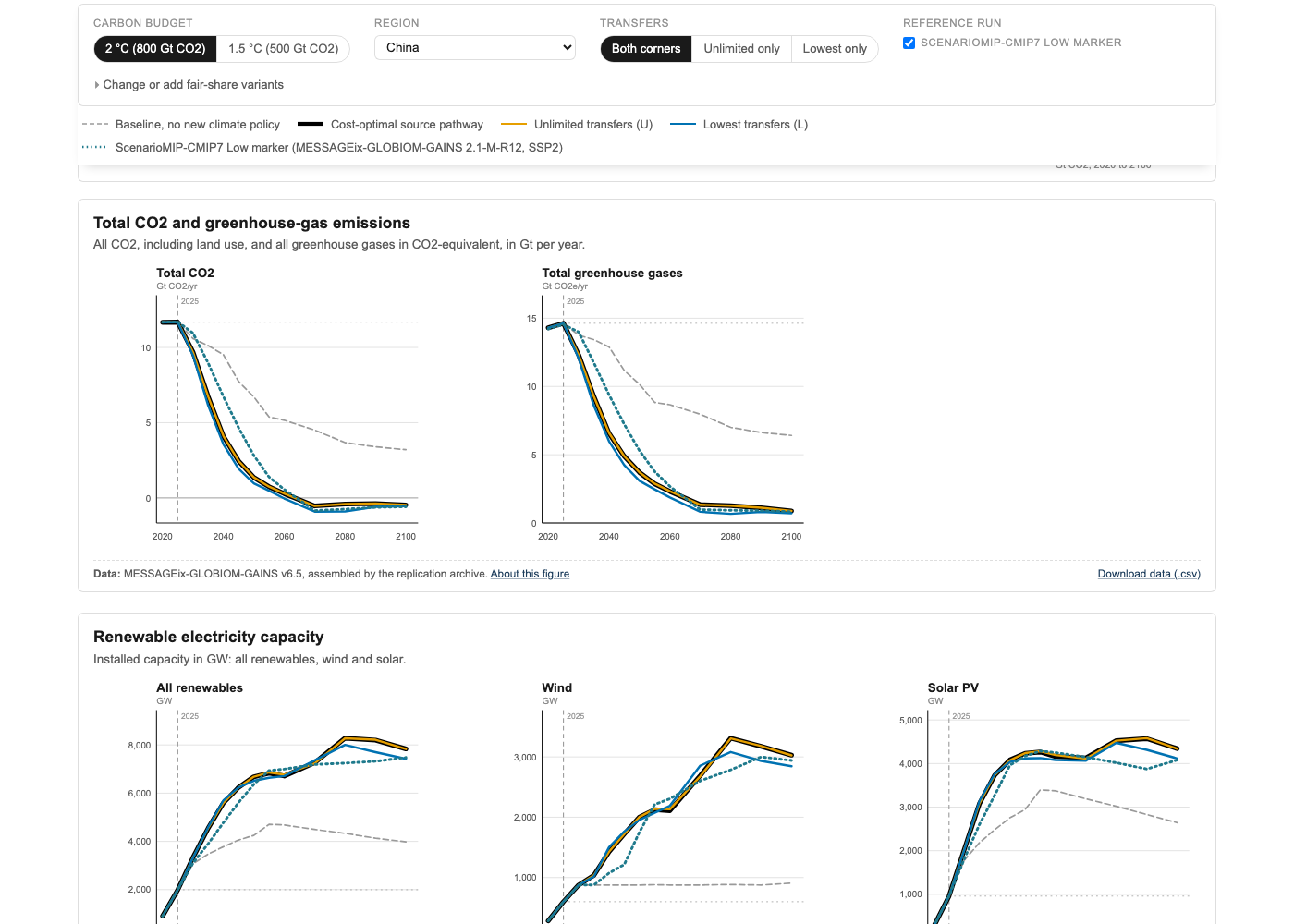
The Equitable Cooperation Explorer is the webapp that accompanies our Environmental Research Letters paper on equitable cooperation in mitigation pathways (Pelz et al., 2026). The paper's argument is that fairness can be built into the generation of a pathway rather than checked afterwards, and that doing so widens the set of pathways that meet the same climate goal; the tool lets users see that widening indicator by indicator, and region by region, rather than take the paper's figures on trust.
Every card draws one indicator of climate action, from total emissions and renewable capacity to fossil fuel supply, coal power and sectoral emissions, for the cost-optimal source pathway and for the two transfer corners that bound the fair-share solution space: unlimited transfers between regions, and transfers held to the lowest level the model tolerates. A control bar switches between the 2 °C and 1.5 °C budgets, between the World, the two responsibility groups and the twelve model regions, and adds the other allocation approaches, the removal-only mechanism, the delayed-cooperation and discount-rate cases as further pairs. A strip above the cards shows that every line reaches the same cumulative budget, and a reference run overlays the CMIP7 Low marker pathway from the same model for comparison with a scenario built without fair shares.
The explorer lives in the paper's replication archive and is rebuilt from the assembled scenario dataset by one script, so a new scenario set flows through without hand edits.
@article{pelz_equitable_2026,
	title = {Equitable cooperation deepens the solution space for high ambition pathways},
	copyright = {CC BY 4.0},
	url = {https://doi.org/10.1088/1748-9326/aea34d},
	doi = {10.1088/1748-9326/aea34d},
	journal = {Environmental Research Letters},
	author = {Pelz, Setu and Fricko, Oliver and Riahi, Keywan and Pachauri, Shonali and Brutschin, Elina and Rogelj, Joeri and Krey, Volker and Johnstone, Iain and Vinca, Adriano and Schleussner, Carl-Friedrich and Kikstra, Jarmo and Gidden, Matthew J.},
	year = {2026},
}