Equitable cooperation deepens the solution space for high ambition pathways
Fairness built into pathway generation deepens the space of feasible ambition
Explore the scenarios behind the paper
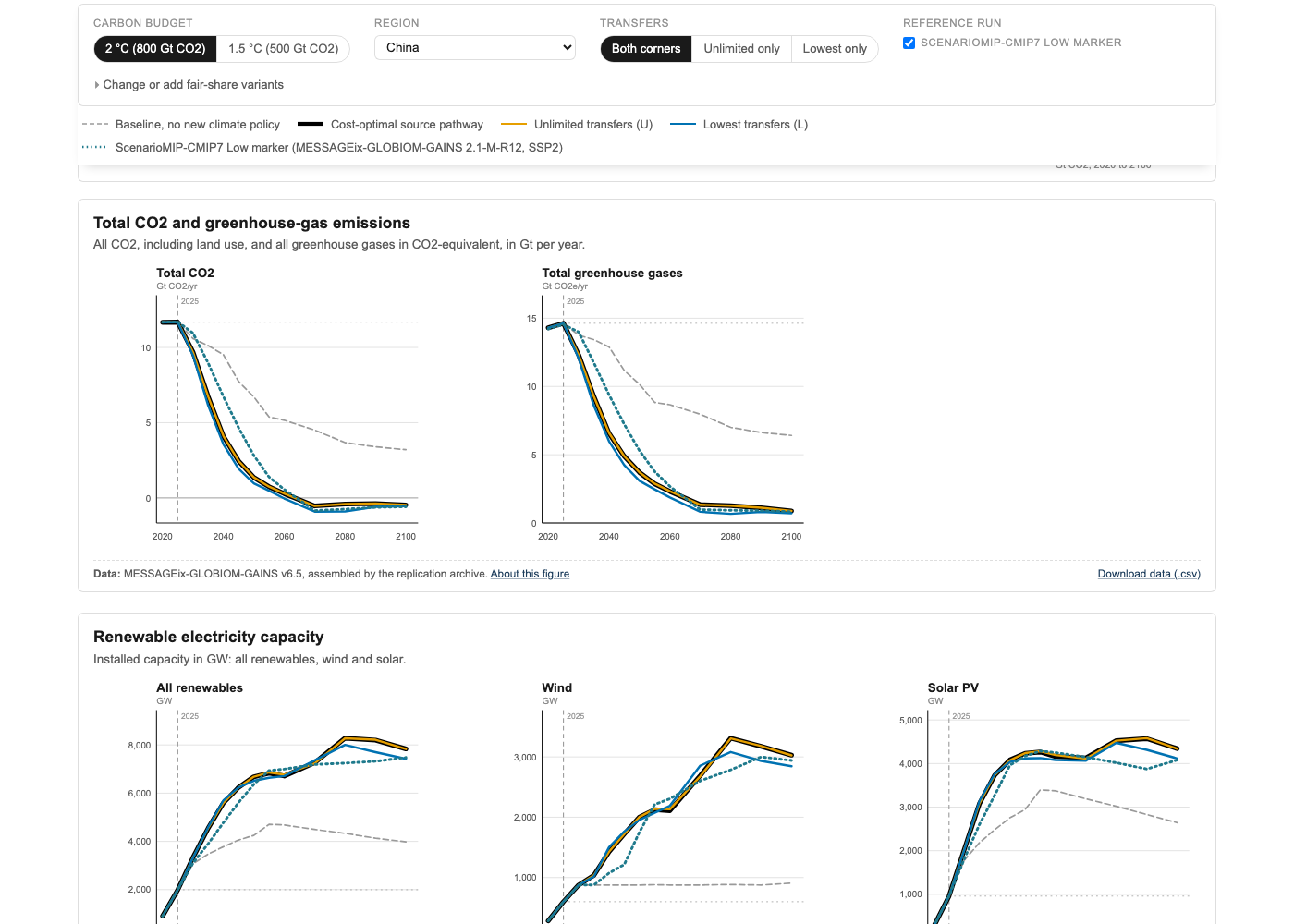
The equitable cooperation explorer redraws the paper's main figures so each mark carries its value, draws the indicators of climate action for every pathway in the paper, by region and by budget, and includes a comparison to the CMIP7 Low marker pathway from the same model.
Fairness is assessed after the pathway is fixed
Global mitigation scenarios that inform climate ambition are built to find the least-cost route to a temperature goal, and fairness typically enters afterwards, when analysts compare each region's modelled effort against a principle-based allocation and report the gap. This ex-post reading is well established, and it produces a familiar conclusion in which fair effort-sharing and urgent collective action appear to be in tension, with finance required to close the gap.
We ask what changes when fairness is a design constraint during scenario generation. That is, we test whether a pathway to 1.5 °C or 2 °C survives once principle-based 'fair shares' are imposed at the point where the scenario is generated and regions are allowed to cooperate to meet them, both when the finance for that cooperation is unconstrained and when it is constrained.
A framework that starts from any existing scenario
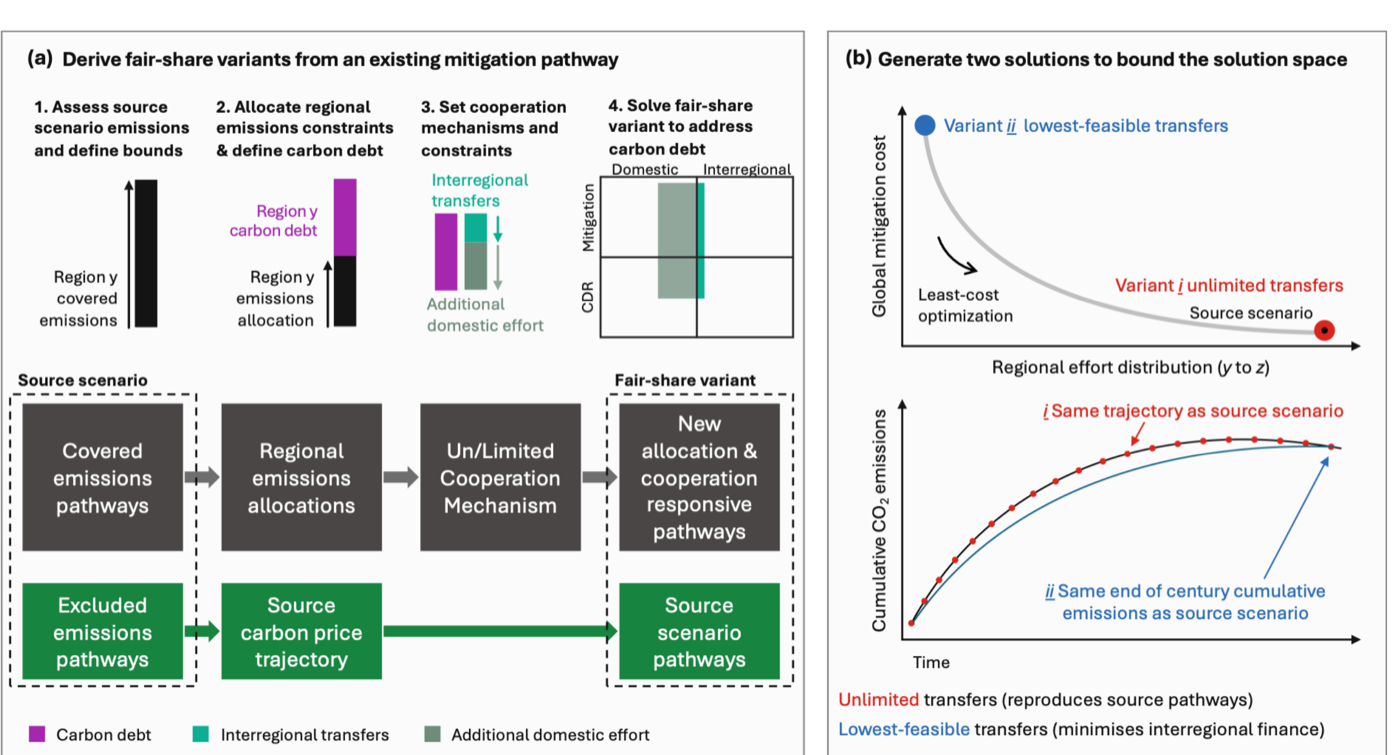
The framework takes a globally cost-effective source scenario and splits its emissions into a covered set, allocated to the twelve model regions by a fairness principle, and an excluded set (land use, international shipping and aviation) that keeps the source carbon price. Regions that have already used more than their allocation carry a net-zero carbon debt, which they must close through some combination of deeper domestic gross reductions, domestic carbon removal, and cooperation with other regions, with cooperation solved inside the model so that the price of transferred allocation emerges from it rather than being imposed on it.
Two corner solutions bound the space. Under unlimited transfers, regions may finance mitigation in other regions through interregional transfers rather than mitigate further at home, so the physical pathway reproduces the source scenario and the corner prices the fair-share obligation; this reproduces the classical equity-efficiency result and is the analogue of the ex-post fair-finance quantifications in the existing literature. The lowest-feasible transfers corner is the paper's addition: finance is held to the minimum the model needs to remain feasible, starting from the roughly 100 billion USD per year already committed, so that meeting regional fairness requires shifts in the energy system itself. Building on this, we explore six allocation approaches (equal and capability-adjusted cumulative per capita, from 1990, 2015, or 2025), a removal-only cooperation mechanism, a ten-year delay, and two carbon budgets.
Both budgets run from 2020 and allow overshoot, with 800 Gt CO2 consistent with limiting warming to approximately 2 °C at 67% likelihood and 500 Gt CO2 consistent with 1.5 °C at 50% likelihood, in each case by exceeding the limit and returning to it.
The climate outcome holds while the fossil exit accelerates
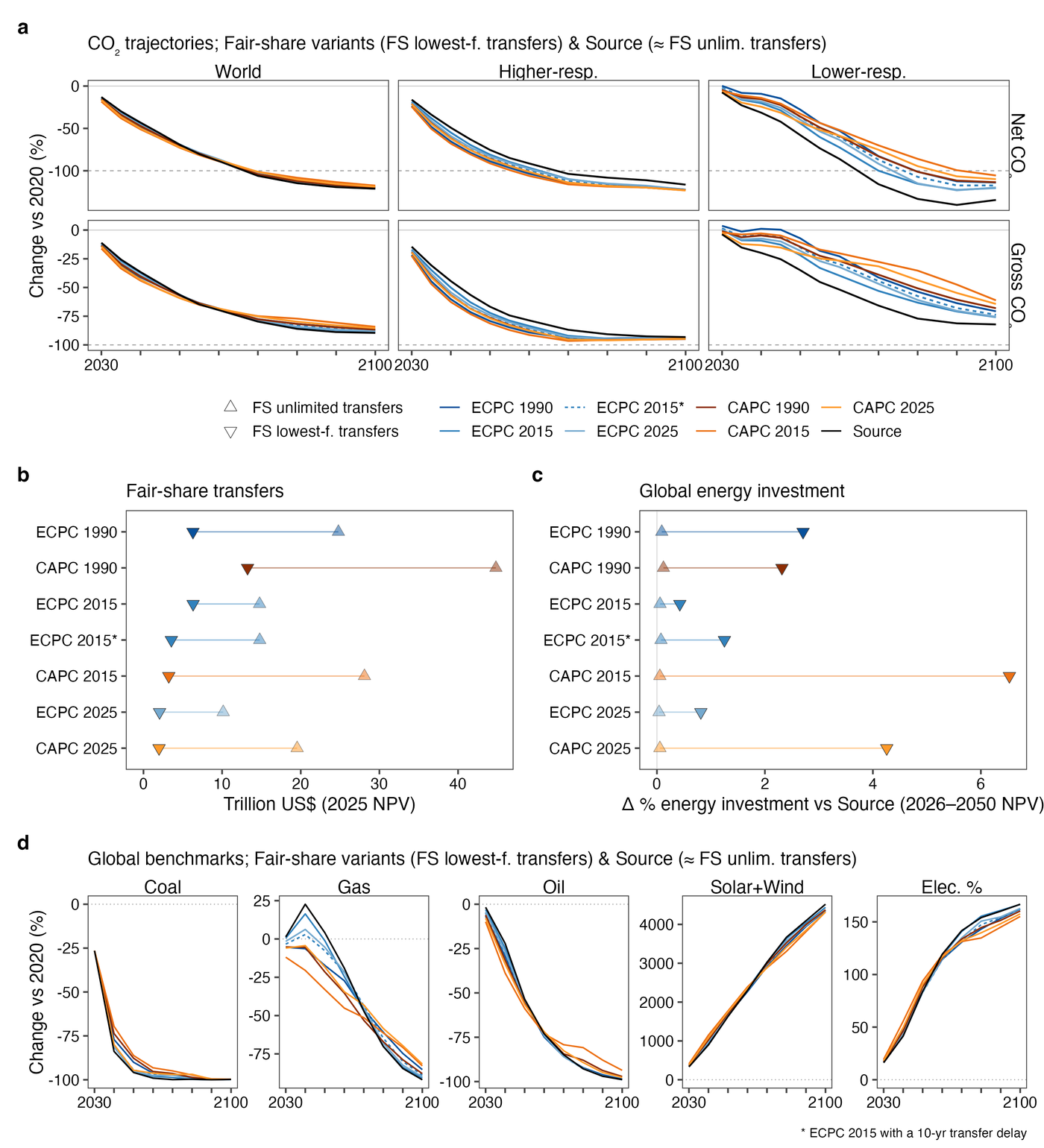
We find that both transfer corners reproduce the source scenario's end-of-century net cumulative CO2, indicating that fairness and ambition are not inherently in tension, and that global renewables deployment and electrification are largely indistinguishable across variants, the difference lies in the pace of the fossil exit. When transfers are held to lowest-feasible volumes, higher-responsibility regions reduce faster at home and global fossil primary energy in 2040 falls 3 to 21% below the unlimited-transfers case depending on the allocation approach, while the transfer obligation of 10.1 to 44.8 trillion USD (NPV, 2026 to 2100) implied by unlimited transfers is cut by more than half.
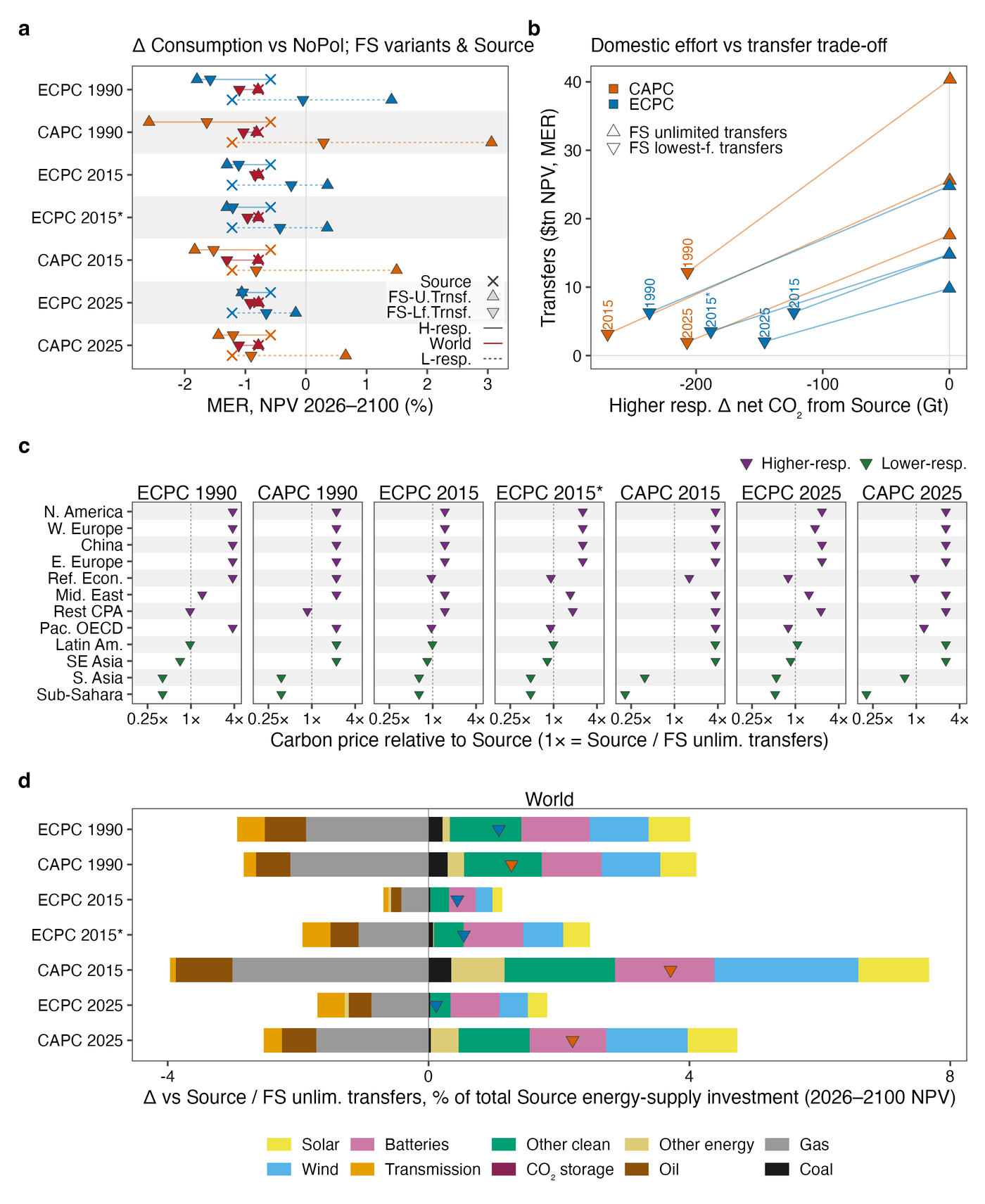
The aggregate cost is small and its distribution progressive. A cost-effective 2 °C scenario lowers global consumption over 2026 to 2100 by approximately 0.8% in present-value terms, or 1.1% undiscounted, relative to no new policy. Unlimited transfers leave that unchanged, because they only redistribute. Lowest-feasible transfers raise it to at most 1.3%, and every lower-responsibility region gains relative to the cost-effective pathway. Extending historical responsibility back to 1990 scales the financial flows rather than the physical transition, and delaying cooperation by a decade roughly triples the near-term increase in global energy investment. Under a 1.5 °C budget the solution space persists, though with less room to shift energy systems and with differentiation settled increasingly through finance.
Why restricting cooperation to carbon removal raises the cost
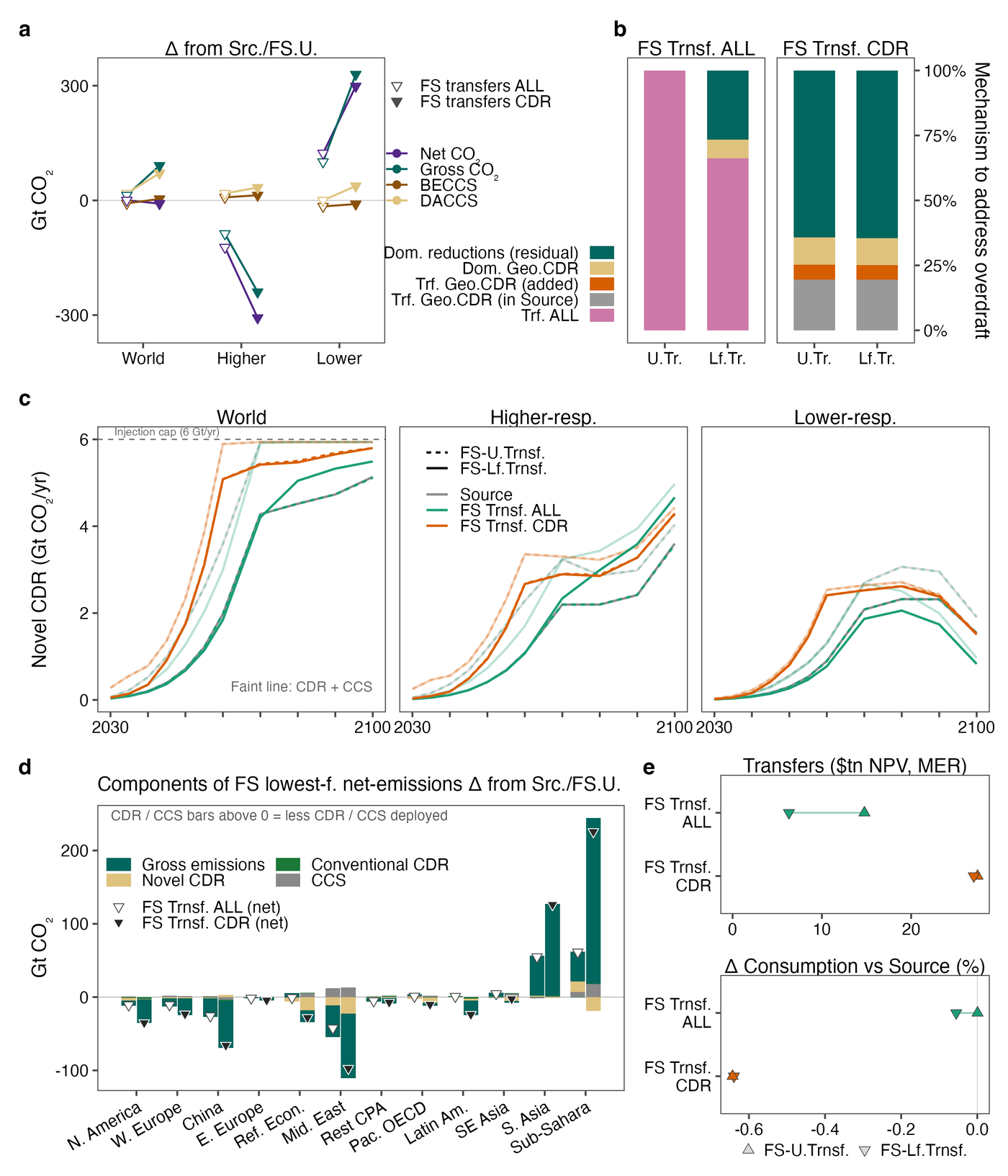
International cooperation may in practice be channelled through specific instruments, so we also restrict transfers to financing novel carbon dioxide removal, that is bioenergy with carbon capture and direct air capture with geological storage. Under this restriction the fair-share variants diverge from the source scenario even when finance is unconstrained, and the transfer volume changes little between the corners, at roughly 27 trillion USD in both, because the volume of removal that can be transferred is set by technical and geological limits rather than by cost. Expressed per tonne of mitigation transferred, cooperation restricted to removal costs approximately 220 USD, against 20 to 30 USD when all mitigation options are in scope, and the global consumption loss relative to the source scenario rises from marginal to just over 0.6%.
Notably, even with cooperation restricted to carbon removal, the response remains one of gross emissions reductions first: roughly two-thirds of the higher-responsibility overdraft is met by deeper domestic gross reductions, with domestic removal covering a further tenth, while geological sequestration scales up to its injection limit around mid-century, well ahead of the source scenario. The regional responses are heterogeneous, in that Sub-Saharan Africa expands direct air capture at the expense of industrial capture as an export resource, whereas South Asia develops no additional removal capacity under its modelled constraints. None of this follows from the simple reallocation of removal that fair-share studies conducted outside model frameworks tend to assume.
Fairness as a feature of feasibility, not a constraint on ambition
None of these dynamics are visible in ex-post fair-share assessments of cost-effective scenarios, and they emerge only when the scenario generation process itself accounts for differentiated responsibilities and capabilities. Under constrained finance, a 'gross emissions reductions first' strategy among higher-responsibility regions appears to release pressure on lower-responsibility regions, and the window for regional differentiation remains open even where the remaining 1.5 °C budget is exhausted before the first model step.
The results quantify the aggregate potential of interregional cooperation, market and non-market, and neither prescribe carbon market designs nor endorse Article 6 mechanisms to cover NDC shortfalls. They also externalise climate damages and rest on two principle families in one model. In summary, we argue that scenario assessments should routinely explore fair-share variants, and lowest-feasible transfers in particular, alongside cost-effective pathways as the next NDC cycle and the second Global Stocktake approach.
See the pathways for yourself
Every claim above can be checked in the explorer, which is built from the same scenario data as the paper and lives in its replication archive.
- Figures 2 to 5 of the paper as interactive panels, with each figure's data available as a table
- Indicators of climate action for the cost-optimal source pathway and the two transfer corners, for the World, the two responsibility groups and each of the twelve model regions
- Both carbon budgets, every allocation approach, the removal-only mechanism, the delay and the discount-rate cases
- A comparison to the CMIP7 Low marker pathway from the same model
@article{pelz_equitable_2026,
	title = {Equitable cooperation deepens the solution space for high ambition pathways},
	copyright = {CC BY 4.0},
	url = {https://doi.org/10.1088/1748-9326/aea34d},
	doi = {10.1088/1748-9326/aea34d},
	journal = {Environmental Research Letters},
	author = {Pelz, Setu and Fricko, Oliver and Riahi, Keywan and Pachauri, Shonali and Brutschin, Elina and Rogelj, Joeri and Krey, Volker and Johnstone, Iain and Vinca, Adriano and Schleussner, Carl-Friedrich and Kikstra, Jarmo and Gidden, Matthew J.},
	year = {2026},
}